Archive for August, 2009
From wikipedia:
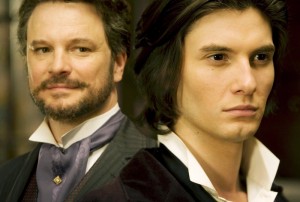
The novel tells of a young man named Dorian Gray, the subject of a painting by artist Basil Hallward. Basil is impressed by Dorian’s beauty and becomes infatuated with him, believing his beauty is responsible for a new mode in his art. Talking in Basil’s garden, Dorian meets Lord Henry Wotton, a friend of Basil’s, and becomes enthralled by Lord Henry’s world view. Espousing a new hedonism, Lord Henry suggests the only things worth pursuing in life are beauty and fulfillment of the senses. Realizing that one day his beauty will fade, Dorian cries out, expressing his desire to sell his soul to ensure the portrait Basil has painted would age rather than himself. Dorian’s wish is fulfilled, plunging him into debauched acts. The portrait serves as a reminder of the effect each act has upon his soul, with each sin displayed as a disfigurement of his form, or through a sign of aging.
The 1945 adaptation of Wilde’s novel starred the wonderful George Saunders as Lord Henry Wotton (best known for playing Rebecca’s sinister cousin in Hitchcock’s 1940′s eponymous classic, and Addison DeWitt in All About Eve), Angela Lansbury, Peter Lawford, and Donna Reed. This version stars Colin Firth and Ben Barnes as Lord Henry and Dorian Gray, respectively.
Release Dates (currently no US
):
UK – 9 September 2009
Canada – 11 September 2009 (Toronto Film Festival)
Greece – 17 September 2009
Italy – 23 October 2009
Australia – 12 November 2009
Finland – 25 December 2009
One of the most striking differences between American women and English women was the role each played after marriage. The young American girl was sophisticated and cultured, with easy ways and unconscious charm when compared to her English counterpart, but in American society, the position of a married woman was rather restricted to home and hearth. Yes, aristocratic English women had lesser rights than American women, but upon their marriage, they were expected to not only run a large and extensive household, but to support their husband in his choice of career–especially within the political sphere. Because of this gulf in upbringing, more than a few young American heiresses floundered in their new position (and ironically, many American women married to American men chose to live abroad because of the increased social position and freedom post-marriage). In England, women ruled not only on the throne, but in the halls of Westminster. So important was the political hostess to her husband’s career, a gentleman in pursuit of a suitable bride would more often overlook the beautiful, gay young lady for her plainer and quieter, yet better-connected and erudite counterpart.
In the past, titled women such as Georgiana, the Duchess of Devonshire, whose “kisses won the votes of Covent Garden porters for Fox,” and others like Elizabeth, Duchess of Northumberland, the Duchess of Portland, the Countesses of Derby and Beauchamp, the Ladies Waldegrave, etc, all “reveled in election fights in the days when every man knew how his neighbor had voted, and when polling days were marked by fierce rioting and savage intimidation.” By the Edwardian era, it was acceptable for women to canvass for votes, make speeches and otherwise take public part in their husband’s political campaigns. The most notable was Lady Randolph Churchill, who made waves both during the extent of Lord Randolph Churchill’s career, and that of her son Winston’s–her plea, “Never mind about dear bread. Vote for dear Winston,” when he was fighting for election in North Manchester became infamous.
The social success and personal satisfaction of a political wife obviously depended on her own temperament as well as her husband’s talents and popularity. An accomplished political hostess could oil the wheels of her husband’s career, though a talented hostess could rarely push her husband’s interests if a powerful political enemy halted his progress. Anomalies to this process were Arthur Balfour and W.E. Gladstone, the latter of whom had a retiring wife, and the former, who had no wife at all. Women were denied a formal education but they often were very well read, articulate and knowledgeable about politics, and they grew up immersed in a political atmosphere and revered parliamentary leaders as their heroes, espousing the cause of their family’s party. For example, the Lyttleton, Gladstone and Talbot women were influential on such topics as Irish Home Rule, the complex relationship between Church and State, and the iniquities of Conservative foreign policy.
According to the Every Woman’s Encyclopedia, “Leading political hostesses, of course, take a keen interest in the doings of these leagues and associations, which may be said to keep the rank and file of the parties together. But they also have the responsible duty of furthering the interests of their husband and party by extending to the principal members of the latter cordial hospitality at all times. ‘Given average ability, the young politician who marries a clever wife is bound to come to the front,’ remarked Lord Beaconsfield on one occasion. He was referring more particularly to the clever wife who can maintain a brilliant home, charm people with her conversation, prove a discreet and tactful friend and adviser, imbue others with her enthusiasm – in a word, make people want to cultivate the acquaintance of herself and her husband.”
During the 1880s, women boosted the image of the Conservative Party with the foundation of the Primrose League. In 1885, a Ladies Branch and Grand Council was founded by Lady Borthwick and a committee meeting took place in her house on Piccadilly with the dowager-duchess of Marlborough (first lady president), Lady Wimborne, Lady Randolph Churchill, Lady Charles Beresford, the dowager-marchioness of Waterford, Julia, marchioness of Tweeddale, Julia, Countess of Jersey, Mrs (subsequently Lady) Hardman, Lady Dorothy Nevill, the Honorable Lady Campbell (later Lady Blythswood), the Honorable Mrs Armitage, Mrs Bischoffsheim, and Miss Meresia Nevill (the first secretary of the Ladies Council).
Lady Randolph Churchill spoke thus of the league’s early days in her 1908 memoir:
As a Dame I was determined to do all I could to further its aims. The first years of its existence were a struggle. The wearing of the badge exposed one to much chaff not to say ridicule, but we persisted. Recruits joined surely if slowly and today after twenty five years of existence the League can boast of having 1,703,708 knights dames and associates upon its rolls and of having materially helped to keep the Conservative Party in power twenty years.
The Liberal Party had its own counterpart–the Women’s Liberal Federation, the president of which was the Countess of Carlisle, and the Women’s National Liberal Association–though this had considerably less fame and impact than the Primrose League. Of the political hostesses, they have been discussed extensively in other posts. Needless to say, the Duchess of Devonshire, the Marchioness of Londonderry, and Margot Asquith, among others, were extremely powerful and exerted much influence over their husbands and their protegees. Because of their peculiar status, many of these socially- and politically- powerful women were anti-suffrage, feeling that women did not require the vote because they had always wielded political power. In hindsight we know this was short-sighted, and that their reasoning was obscured by their exalted social status, which by and large protected them from the vulnerabilities women of the middle and working classes faced. Nonetheless, in this period of increasing suffragist protests, women in England were powerful and influential on a public scale.
Further Reading:
Emmeline Pankhurst: A Biography by June Purvis
Political woman by Melville Currell
Women, marriage, and politics, 1860-1914 by Patricia Jalland
The Edwardian Woman by Duncan Crow
1900s Lady by Kate Caffrey
What It Means to Be A Political Hostess and Worker
Since acquiring my Sony Reader, however temporary, I’ve found reading old books from Project Gutenberg has become a lot easier. I connect the USB cord to my laptop, download the book in ePUB or HTML form to the Reader, et voila! I have a novel or short story written by popular Edwardian writers at my fingertips. Many of the authors available on Project Gutenberg or other free ebook websites were extremely popular in their day and would be considered “pulp” novelists today–but just because their fiction hasn’t been canonized as “Classic Literature” doesn’t mean the books aren’t enjoyable. In fact, I find myself downloading more of their fiction than the works of authors published today because most are a perfect blend of humor, romance, and often, mystery, that remind me of romantic comedies and romantic mysteries filmed in the 1930s and 1940s. To dredge the annals of fiction for you, I shall present reviews of some of the books our Edwardian counterparts gobbled up and what I’ve greatly enjoyed today.
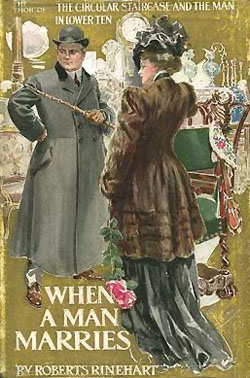
According to wikipedia, Mary Roberts Rinehart was considered the American Agatha Christie and popularized the phrase “The butler did it.” When A Man Marries is typical of both Rinehart’s “Had I but known” shtick (one I find many gothic romances employ) and the “society” fiction narrated in first person by a charming female that was popular after Elinor Glyn burst onto the literary scene with The Visits of Elizabeth (to be reviewed soon).
The plot is slight but oh-so ingenious, as the heroine, Kit, is roped into pretending to be her friend Jim’s wife, when his wealthy aunt, who is unaware that Jim has divorced the high-maintenance Bella, comes to supper. When Jim’s butler is stricken with smallpox, the house is quarantined, inadvertently trapping Kit into being “Bella,” a visiting policeman, the sneaky Bella, who came to the house to steal the butler she and Jim shared, and a handsome stranger with whom sparks fly . Toss into a jewel theft, and you have a wonderful, witty romantic mystery. Beware, there is a bit of offensive racial stereotyping in the beginning of the novel, with the Japanese butler as the butt of the joke, and the policeman’s Irishness and his lower-class status is used as fodder for his characterization, but as this was published in 1910, it is unavoidable. Otherwise, though the mystery element takes a backseat to the romance and the humor, it is sufficiently suspenseful to keep you wondering who the culprit is!
Excerpt:
The minute I had consented I regretted it. After all, what were Jimmy’s troubles to me? Why should I help him impose on an unsuspecting elderly woman? And it was only putting off discovery anyhow. Sooner or later, she would learn of the divorce, and—Just at that instant my eyes fell on Mr. Harbison—Tom Harbison, as Anne called him. He was looking on with an amused, half-puzzled smile, while people were rushing around hiding the roulette wheel and things of which Miss Caruthers might disapprove, and Betty Mercer was on her knees winding up a toy bear that Max had brought her. What would he think? It was evident that he thought badly of us already—that he was contemptuously amused, and then to have to ask him to lend himself to the deception!
When A Man Marries – Project Gutenberg
When A Man Marries – Many Books
Review – The Mystery File