Archive for May, 2009
When stationed abroad–or sent away for some nefarious reason or other–the English imported the manners and mores of Home to their new locale. As the British Empire grew, spreading across Asia, Africa and Down Under, it was imperative to maintain ‘civilization’ and ‘culture’ in the midst of ‘brutish’ nations. Though the leading official of Britain’s colonies, and later, commonwealths, were referred to as “Viceroys,” their accurate title was that of either Governor-General or Lord Lieutenant. Of the Viceroyalty, India, that jewel in the crown of the Empire, was the most coveted position.
In these territories, society revolved around the Government House. Though an invitation to Government House was considered no more exclusive than attending a Court ball in London, it was coveted as a symbol of at least hovering on the fringes of society. In Melbourne, Australia, the scattered position of the suburbs created a number of elite circles, but there remained but one creme de la creme–and in Sydney, the same thing occurred. However in Adelaide, there was but one society, and they were considered the most English and exclusive. However exclusive these circles may be, class was a fluid concept because of the skewed ration of men versus women. Australian writers describing their country bemoaned the frequency of mesalliances, and detailed stories abounded of being invited to dine at the home of a cultured man and discovering the man’s wife dropped her h’s and ate her peas with a knife. Richard Twopeny, in his book “Town Life in Australia” noted that the rule of Australian society was to avoid asking questions about or making reference to the early days of a colonist–it was likely that a society leader and her husband were formerly a scullery maid and shop-keeper, respectively.
This melding of various classes and socio-economic backgrounds led to a startling informality. The man-about-town would dress down rather than up for his Sunday stroll (a top hat, gloves and waistcoat would bring jeers), and the dearth of servants–for people emigrated to start anew!–induced many Australian ladies to pitch in and clean their homes and cook themselves.
New Zealand society was just as informal, if not more so. They had their Government House in Wellington, and to receive an invitation to a ball, one had only to sign their name to the Visitor’s Book and await the square of pasteboard to arrive. New Zealand ladies thought nothing of setting out to pay formal calls on foot–though with a pistol handy in case of emergency. Because of the great distances between settlers and cities, social gatherings went on for days: one dance lasted for a day, a night, and another night. Of other amusements and entertainments, the opera was very popular, and there was a mania for gambling. Not surprisingly, long after the fad for rinking (roller skating) was introduced to England and America, it became a craze in Australia, and it was noted that there was no set hour for the fashionable to use the rinking rings; a maid could sail past her employer and even link arms with the daughter of the house. Sports were a given past-time, with pony races and dingo hunts indulged in by the men.
The delightful informality of society in New Zealand and Australia ended there. Society in places like India, Hong Kong and Shanghai centered around Government House, but the presence of the military in other British colonies and dominions reinforced English social patterns–though the elite of Hong Kong and Shanghai society were more likely to derive from the merchant classes.
The seasons–cold, hot or wet–dictated the pattern of British society in India, and the club did the rest. Every center except the smallest had a club, whether it be called a club or were actually a polo or gymkhana club, and joining it was the most important step in becoming accepted in that area’s society. The cold season, lasting from November to April, was marked by the arrival of the “fishing fleet”–the collective name given to girls with family connections in India who came out to snare a husband. Christmas, with pea fowl rather than turkey, and presents ordered from Home in October, was the climax of this portion of the season, and after that, the Viceroy’s Ball at Delhi carried he message that the hot weather, with its temperatures of 130 degrees in the shade, would shortly begin. Society decamped to hill stations like Simla (Shimla), Musoori (Mussoorie) and Darjeeling to escape the heat, and left the men behind to their employment and masculine pursuits. The hills were very much the woman’s world, and was organized along the lines of the London season. This “hot” season ended in October, when the memsahibs and their families once more returned to the Plains for the “cold” season.
Society in Hong Kong and Shanghai was unlike any other. Here, merchants ruled supreme, though to outsiders, the hierarchy was extremely puzzling: why should Mrs. X whose spouse exports tea be “haut ton,” while Mrs. Y whose husband imports cigars is not to be called on? A further source of surprise was that officers in the Indian Army were not considered eligible dancing partners for the daughters of the Hong Kong elite. The firm of Jardine Matheson was the “Princely Hong” since the founder, William Jardine, a ship’s surgeon, could claim to have “discovered” the island of Hong Kong. A Crown Colony ruled by a Governor-General and a Council, society was less formal than India, though not as informal as Down Under. Because of its position as a major port, the British mingled with a bevy of nationalities and occasionally the very wealthy Chinese. However, the stench of opium trading hung over both Hong Kong and Shanghai, lending the two trading ports a sinister air.
Like India, Hong Kong society was dictated by its season: for six months out of the year the island was extremely hot, and that was alleviated only by a southwest monsoon. To escape the summer heat, society built houses on the Peak–though this was little better for it was extremely wet and foggy. Fog would sometimes envelop the Peak for days and drown everything in moisture–books became moldy and dropped from their covers, shoes turned green with a single night’s experience, and clothes were so saturated with the clammy touch of the mist that they could not be worn. To combat this, every house had a drying room, where fires burned all day long, and where bed-clothes and garments were dried. Shanghai was divided into three settlements–English, French, and American–and the Chinese city of Shanghai proper was two miles distant and walled, for the Chinese were forbidden to move freely without permission. The best weather occurred between September and May, and after that, it was frequently described as “hell.” It was a bit more sophisticated and cosmopolitan than Hong Kong, influenced by the lavishness of the American element, and many considered it a rival to the best cities in Europe.
Regardless of how far away they were from England, most colonist considered that to be “Home.” After the turn of the century, colonists in places like Canada, Australia and South Africa were the settlers began to see themselves as anything other than British, and began to develop unique identities as “Canadian” or “Australian.” However, despite the strict adherence to British social customs in colonized countries, the influence went both ways, with the countries adopting certain aspects of British culture, and British culture absorbing the customs of the other country.
Further Reading:
Australia from a Woman’s Point of View by Jessie Ackermann
The scenery, life and manners of Australians in town and country by Percy Clarke
Australia and the Islands of the Sea by Eva Mary Crosby Kellogg & Larkin Dunton
Town Life in Australia by Richard Twopeny
The Real Australia by Alfred Buchanan
Diary of a lady’s maid: Government House in colonial Australia by Emma Southgate, Helen Vellacott
Pictures of Southern China by John Macgowan
China, the Long-lived Empire: The Long-lived Empire by Eliza Ruhamah Scidmore
Personal Reminiscences of Thirty Years’ Residence in Shanghai by Charles M. Dyce
Out in the Noonday Sun by Valerie Pakenham
Women In Great Social Positions:
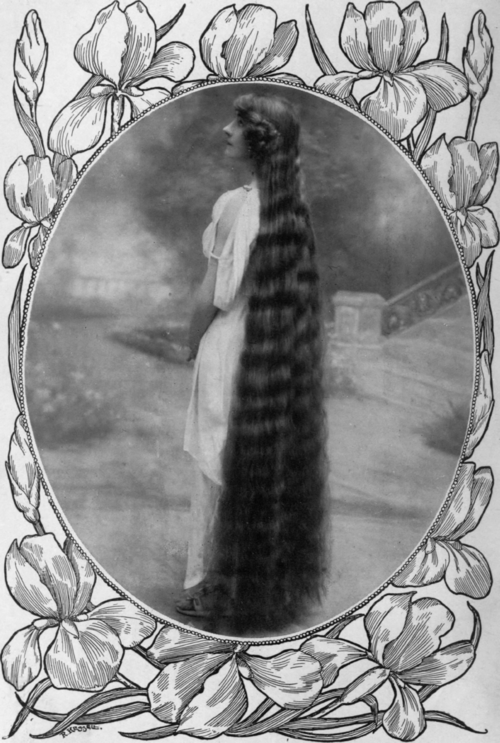
Mlle. Aline Vallandri, the famous Cantatrice, who has the Most Wonderful Hair in Europe, tells her Secrets to an Interviewer for Every Woman’s Encyclopaedia:
It is not difficult (she says) to set down the rules I follow for taking care of my hair. Greatly as I prize and value my gift, I am no slave to it, for I devote only about three-quarters of an hour every day to its care. If women generally did the same, I have no doubt that in a short time they would soon notice an improvement in the condition of their hair.
The first essential, in my opinion, is to keep both the scalp and hair perfectly clean. It may seem superfluous to say that to women who realise the necessity of keeping the whole body clean. Especially is this the case with regard to Englishwomen, who have a bath every day. I am perfectly certain that much washing of the hair with water is bad. As a matter of fact, I wash my own hair as seldom as possible. I cannot give any exact interval of days or weeks when the hair is to be washed, for that depends on circumstances.
In the dark, foggy days, when there is much dirt and soot in the air, the hair naturally gets more dirty, and may therefore require more frequent washing than in the light, bright days of summer. Still, even under these conditions, it is possible by much brushing to avoid any excessive use of water.
When the hair is washed, it should be allowed to hang down until it dries naturally in the air, as I do not believe in rubbing it with a towel or using hot irons for the purpose of driving off the moisture. Those things are bad – very bad. Hot irons ruin the hair. The woman who uses curling-tongs courts disaster. The heat dries up the natural oil which is supplied by the little oil glands at the roots of the hair and keeps it soft and moist. The result of tongs or of heat is to make the hair brittle, so that it breaks off short. It stands to reason that if you are constantly breaking the hair it will never get long.
Only once in my life did I ever have my hair curled with curling-tongs. That once taught me my lesson. The hairdresser used irons which were too hot, and he burnt a lot of the hair in the middle of my head. Since that day no hot irons have ever been put near my hair.
How Often To Clean Brushes
Although I so strongly disapprove of washing the head with water, it is possible, as I have said, to keep the scalp and the hair quite clean by brushing it. To do this, perfectly clean brushes are absolutely necessary. My own brushes are washed every day. When once a brush has been used it is never allowed to touch my hair again until it has been thoroughly washed and dried. Doing this regularly becomes a matter of routine, and it takes scarcely any time at all, although I know only too well that when these things are done only occasionally they seem to take a great deal of time. Another reason for brushes taking so much time when they are only washed occasionally is that they are really dirty, and to clean dirty brushes must necessarily take longer than to wash those which have only been used once. If you think of it, it is no more nice to brush your hair with dirty brushes which have not been washed for two or three weeks than it is to dry your face with a towel which has not been washed for the same time.Every morning when I get up my maid brushes my hair. As it is so long I have had to have a specially high stool made to sit on. The maid brushes both my scalp thoroughly and my hair from the roots to the end for half an hour. The other quarter of an hour I devote to dressing it for the day.
In addition to keeping the hair perfectly clean, this brushing prevents the possibility of any scurf or dandruff – and scurf is death to the hair. It may come because the hair is too dry, or it may be due to the hair being too greasy. To whichever cause it is due it should be cured at the very earliest moment it is seen, so that it may not cause the hair to drop out, as it most assuredly will if it is neglected. I should strongly recommend the doctor being called in when there is scurf, but sometimes a home remedy like “golden ointment,” which is a compound of mercury, will cure the condition rapidly. In that case, what I have said about washing must be ignored for the time. The ointment must be well rubbed into the roots of the hair at night, and washed out the next morning. In the course of a week of this treatment the scurf ought to be quite cured.
If the hair is very dry, it is a clear indication that the little oil glands are not supplying enough nourishment. This must, therefore, be supplemented by the use of a little good brillantine. It is not a good thing to put it on all over the hair. What should be done is to dip the tips of the ringers into the brillantine and rub it well into the scalp until you feel a distinct tingling. The result of this massage causes the blood to circulate very freely in the scalp, and so takes to the oil glands the material they need to make the oil they secrete. At the same time the glands are stimulated to take up the oil which has been rubbed into the scalp, so that the massage acts in a two-fold manner.
Dry hair is invariably dull hair. Now, there is an undoubted beauty in seeing hair shine and reflect the light. This effect is produced by the natural oil, supplemented by the use of the brush. When, therefore, the natural oil is absent, it is well to put the smallest quantity of brillantine on the palm of the hand, and then rub the bristles of the brush over the palm. In this way they get an infinitesimal quantity of oil on them. This little is, however, quite sufficient to make the hair shine without being enough to damage the hair in any way, provided that the brush is used enough.
The Value Of Massage
I need scarcely say that as the oil glands improve in health by the massage, the need for even the exceedingly small quantity of artificial oil will be done away with, and the daily brushing will be quite sufficient to give the hair that wonderful sheen and lustre which are so desirable.
One of the Queens of France, who was famous for the beauty of her hair, used to make her maid brush each of the four strands, into which she divided her hair when it was dressed, a hundred times. And her hair always grew luxuriantly and kept its beautiful youthful appearance all her life.
Another advantage of brushing the hair so much is to give a sensation of great lightness to the spirits. Indeed, a headache can often be cured by massaging the aching part and then well brushing the hair.
People often ask me whether I believe that cutting the hair and singeing the ends with a lighted taper is beneficial for the growth. I am quite sure they do great good. I have the ends of my hair cut and singed very often.
With many people the ends of the hair have a great tendency to split. In the first place, if these ends are kept cut, the splitting will be prevented, and, in the second, if the ends have split, the cutting will prevent the split from proceeding farther and ruining the hair.
Just as the gardener cuts the branches of the young trees to make them grow stronger, so, it would appear, it is necessary for us to clip the ends of our hair if we would have it attain the most luxuriant growth of which it is capable. Indeed, the habit of the gardener in taking care of the beautiful flowers which are entrusted to his keeping might well, and should undoubtedly, be followed by every woman with regard to her hair and that of her daughters.
It was no doubt this care bestowed on my hair when I was a girl which helped to make it grow so long. As a matter of fact, when I was a child I was not noted for the length of my hair. It was no longer than that of any of my companions. By the time I was thirteen or fourteen it had reached my waist, and many girls have hair as long as that. It was when I was sent to a convent to finish my education that my hair began to grow luxuriantly. One of the nuns had a special lotion which she used for her hair. She gave me the recipe for it, and I have used it ever since. Unfortunately, I cannot make the recipe public, as I promised to keep it a secret. Every doctor, however, can give a prescription which, if persevered in, will make the hair grow.
One thing which I find disconcerts some women, and is even a matter of grave concern, is that, at times, their hair falls out. Mine does, too. Sometimes, indeed, it comes out almost in handfuls. So much has come out that I have a great big box full of these “combings.” I never worry about it. I know from experience that just as the hair falls out, so it grows again. It is the law of nature.
[Source]
Hair-washing and Care in the 19th Century by Lydia Joyce
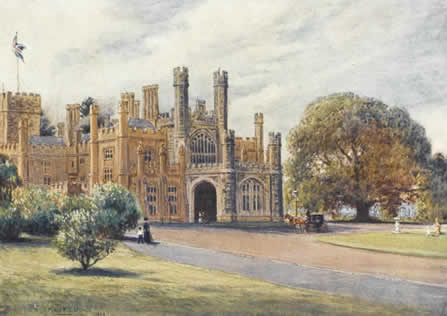
The Country House and its society was taken very seriously by the British. Unlike their Continental counterparts, whose society adhered closely to the movements of the court, the British long acknowledged the countryside as the backbone of the country. The Englishman actually preferred to live in the country, finding on his land a range of sporting activities and like-minded tenants and neighbors; his home was his country seat no matter how much time he spent in London or abroad. According to T.H.S. Escott, the country house as a social entity first appeared during the time of Chaucer, and cemented its purpose as a center of social and political life by the time of the Tudors. Though by the Edwardian era, the country and the country house had begun to lose a bit of its importance, anyone and everyone within “society” knew the quickest way to establish roots and display one’s wealth was to buy a country estate and a few acres, and regularly host house parties.
The years between 1861 and 1914 were considered the “golden age” of country house entertaining. Yes, country house parties existed prior to this time, as seen in Lord Byron’s poem “A Country House Party,” where he indeed described “[t]he politicians, in a nook apart, Discuss’d the world, and settled all the spheres;” but never before was it undertaken in such militaristic order, was it considered a vital part of the year-long social season, and more important–was extremely expensive. It was this great expense–much of it spent entertaining the easily-bored Prince of Wales–that opened the door for the entry of wealthy Jewish families into British (and later on, French, and to a much lesser degree, German) society.
This lavish expenditure had its casualties, and many of Bertie’s closest friends found themselves bankrupt: Sir Christopher Sykes (his sister-in-law had to buttonhole Bertie to get him to pay Sir Christopher’s debts), Harry Chaplin (who had to sell his estates and his possessions), and Daisy, Countess of Warwick (who threatened George V with the publication of Bertie’s love letters to her in order to keep bankruptcy at bay). But while the fun lasted, boy did they have it! Sometimes lasting a week, but usually held from Saturday to Monday (hence the name “Saturday-to-Monday” as the phrase “week-end” was considered a vulgar Americanism), each day was packed with activities.
Though parties were held during the Season at the few recesses in Parliament, August and September were the months for country house parties, as that was the height of the shooting. The former month was generally reserved for the visits of relatives, and many houses focused around cricket. Most people visited the same houses year after year, and if there was an awkward gap between the ending of one house party and the beginning of another, a relative or intimate of the hostess was permitted to remain until departure–the unknown, however, was advised to leave and remain in town until it was time to depart. The latter month was the time for shooting parties, and the first week of September, harvest permitting, was when the crack guns appeared. Etiquette required different form for small shooting parties, large shooting parties, parties to which royalty was invited, and shooting parties held for intimates or relations, but all types lasted three days. Many etiquette books of the time stressed that the success of the house party mainly depended upon people knowing one another–this was important for the men out in the field with the guns, and of particular importance to the ladies, who were expected to amuse themselves while the men went out shooting.
As you can tell, shooting was considered very important to Edwardian men. Landowners vied with one another to produce the biggest “bags” each year, and the numbers increased by leaps and bounds. At the home of the Earl of Pembroke, three days produced 1,236 head, 1,142 head, and 2,276 head, respectively, and this was thought normal. This competitive streak led to the most infamous shoot in 1913 at Hall Barn, a Buckinghamshire estate owned by Lord Burnham, of 3,937 pheasants–which led to even King George V remarking “perhaps we overdid it today.” Against the boom of guns, ladies usually scribbled letters, a practice of much amusement to foreigners who could not imagine how busy an Englishwoman’s life was, creating the need for correspondence on political, social and household topics.
Besides sport, food was one of the more important aspects of a country house party. Guests were free to arrive at breakfast when they so chose, but the proper hour was usually between nine and half past ten. Far from the simple repast enjoyed at the beginning of the nineteenth century, Edwardian guests would feast on fruits, eggs, potted meats, fish, toast, rolls, tea cakes, muffins, hams, tongues, pies, kidney, fried bacon and were given tea, coffee, hot cocoa, and juices to drink. The sportsman’s breakfast was even more substantial, including game pie, cold beef, deviled turkey, broiled ham, kippered haddock, collared eels, spiced beef, shrimp, cold fowl, curried eggs, toasted mushrooms and broiled mackerel among other things, and though tea and coffee were taken, a tankard of beer or a cherry brandy were the drink of choice. Luncheon was included at some houses, though many remained old-fashioned and stuck to the meal times of breakfast, dinner and supper. Luncheons were both formal–with everyone seated by rank–and informal–the gentlemen served the ladies and sometimes children were invited down. The dishes served were a little fancier though similar to breakfast, and beverages included claret, sherry and a light beer. Dinners were more formal, and suppers were the typical sumptuous, formal affairs. Afternoon tea was a given, of course.
Indoor amusements such as word games, charades and practical jokes were the norm, but a passion for gambling overtook the fast set during the 1880s. Baccarat was the initial game of choice and no hostess threw a country house party without a baccarat game. The Prince of Wales was a particular fan of this illegal card game, and until the scandal at Tranby Croft, he carried his own set of counters on his person at all times in case of an impromptu hand. Because of the publicity, baccarat was discontinued in society, and just as quickly as that went out, bridge came in. The craze swept women in particular, and during the early 1900s, the conversation of the most obsessed centered around bridge, bridge, bridge! Ladies were known to play hands in between eating, before going to bed, and would neglect dancing in favor of sitting down for a game in a drawing room. The founding of ladies’ clubs in the mold of gentlemen’s clubs fostered this obsession, for now women would give the same excuse as their husbands as to why they were late to supper or had to hurry into their evening dress.
However, the most engrossing activity of the country house party was sex. Love affairs were the tune of the day, and once a gentleman and a lady had made it known to their hostess that they wished to consummate their attraction to one another, the hostess knew she’d better arrange room assignments to facilitate this. An Edwardian love affair was not an instantaneous matter. The couple in question might spend a few months, or even a few years expressing their affection to one another through letters, and with the amount of clothing involved and the presence of observant servants, getting into bed with one another was not an easy deal–even at a neatly arranged country house party. Anita Leslie tells the story of Lord Charles Beresford who, groping in the dark for his lady love’s bedroom, pushed open the door and leaped into the bed with a “cock-a-doodle-doo!” only to discover he’d slipped between a Archbishop and his wife. Another embarrassing story is that of a hungry guest who wandered through the halls in search of a bite to eat and found a plate of sandwiches on the floor in front of a bedroom door. He satisfied his hunger, ignorant of the intentions meant by the plate and the gentleman hoping for a “yes” from the lady was left disappointed by the tray’s barren surface.
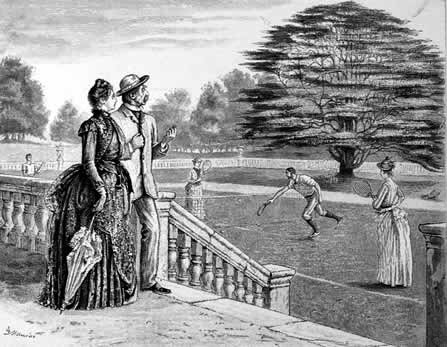
More innocently (or perhaps not), the house party was the last hurrah of that season’s marriage mart. Mama’s who hadn’t caught a suitable gentleman for their daughter that season could count on a house party and its sympathetic hostess to bring the girl in contact with the man of her or her parent’s choice. Activities such as picnics, walks, riding, croquet, billiards and lawn tennis could show off the young lady at her best angle and prove to the gentleman her intelligence and worthiness of being his bride. Other important uses for the country party was its original purpose: politics. The Souls centered around Taplow Court, the home of the Desboroughs, and Stanway House (the Earls of Wemyss), and Nancy Astor’s home at Cliveden formed the setting for a band of Boer War veterans and Pro-Rhodesian Imperialists known as Milner’s Kindergarten. Arthur Balfour, Prime Minister from 1902 to 1905, was a prodigious golfer, and his intense interest in this Scottish sport led to its adoption by hostesses as part of the country house program.
So important was the country house that even royalty took part. After extensive renovation, the Prince of Wales and his family hosted many an important party at Sandringham in Norfolk. Here, the clocks were set forward half an hour–not to accommodate the Princess of Wales’s habitual tardiness as many memoirs claim, but to allow more time for hunting. Because of this, that half-hour ahead was known as “Sandringham Time.” The motor car made it easier to get to country house parties, and newspaper reports of the 1910s bemoaned the emptiness of London due to the dash of society to the country every Friday evening in their motors. Though the Great War further decimated the political importance of the country house, it remained and has remained a symbol that “All’s right with the world!”
Further Reading:
The Country House Party by Phyllida Barstow
The Marlborough House Set by Anita Leslie
Society in the Country House by Thomas Hay Sweet Escott
Manners and Rules of Good Society by A Member of the Aristocracy
Etiquette of Good Society by Lady Colin Campbell
“A Country House Party” by Lord Byron in A Satire Anthology by Carolyn Wells