Archive for January, 2009
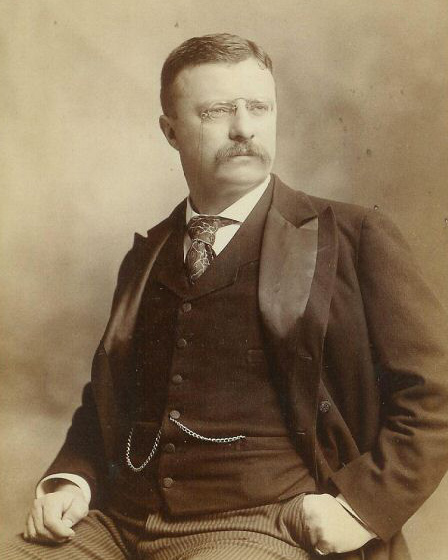
“Booker T. Washington, the well known negro educator and President of the Tuskegee, Ala. institute , was a guest of President Roosevelt and Mrs. Roosevelt at dinner at the white house tonight.”
It was a day like any other when the White House Social Calendar, a regular column in the newspapers of Washington D.C, inserted a tiny line stating that on October 16, 1901, Booker T. Washington had been a guest of President Roosevelt at dinner. overnight the dinner became a sensation. Southern newspapers who had previously held Washington as an example of a “good negro” after his infamous Atlanta Compromise address in 1895, now felt betrayed, and turned to attack both Washington and President Roosevelt with a rabid fervor. Men who had never supported Roosevelt swore to never vote for him again, and many whites revoked their trust in Washington.
In the ensuing silence from both the White House and Tuskegee, it fell to the nation’s newspapers to publicize the opinions of Americans. One southerner sent the President a possum with a card around its neck bearing the name “Booker Washington.” To one of his callers the next day, a friend of the
President reported him as saying “I do not need to give you an explanation of the Booker Washington affair, do I?” President Roosevelt went on to say that he was amazed that he could be so misunderstood by those who had criticized him. Maryland Democrats seized upon this to ridicule the President and the Republican Party, and many claimed that the Booker Washington incident would usher in a Democratic victory.
What made this dinner so remarkable?
Firstly, because it was a private, family affair. Washington had previously dined with a president (McKinley), and President Cleveland had invited Frederick Douglass to the White House, but both were in official, public capacity. By inviting Booker T. Washington to dinner as though he were just another honored guest was shocking, repulsive, outrageous, offensive. Secondly, because it implied that President Roosevelt was opposed to racism and the ever-expanding Jim Crow laws. And lastly, because it implied, for W.E.B. DuBois-supporters, that Washington’s socio-political stance had been granted sanction by the highest in the land.
President Roosevelt’s invitation to Dr. Washington was provocative. Though Roosevelt, like most Anglo-Saxon Americans of that time period, still held to certain assumptions of and prejudices against blacks, the fact that he was willing to break bread with a black man–and that his family were present as well–was astounding in a time period where the advances and tentative healing made during Reconstruction were receding to the point of memory.
Further Reading:
“The First President to Entertain a Negro, Booker T Washington Dined”
Roosevelt, the Happy Warrior By Bradley Gilman
Booker T. Washington By Louis R. Harlan
There is no other expression of American democracy than the exit of one President for another. Whether the President has served one term or two–or in the case of Franklin Delano Roosevelt, four–the inauguration ceremony is one of excitement, triumph and the bittersweet. The first inauguration was held on April 30, 1789, in New York City. The day was originally set for March 4, which gave electors from each state just about four months after Election Day to cast their ballots for president. This was changed in 1937 by the 20th Amendment, which changed Inauguration Day to noon on January 20, in time for Franklin D. Roosevelt’s second term. Thomas Jefferson became the first president to be sworn in at our nation’s capital, though D.C. did not official become the federal capital until 1801.
All inaugural ceremonies at the Capitol have been organized by the Joint Congressional Committee on Inaugural Ceremonies since 1901, and the U.S. military has participated in Inauguration Day ceremonies from the first president, as the president is commander-in-chief of the armed forces. Naturally, the proceedings for the inauguration of a new or continuing president were strictly regulated by etiquette.
It was customary for the President-elect to arrive in the city one or two days before the time designated for his formal induction into office. Upon the arrival of the President-elect at the Capital the national colors would be floated from all public buildings during each day between sunrise and sunset until after the inaugural ceremonies. As soon as practicable after his arrival the President-elect would call upon the President, having previously sent a messenger to ascertain his convenience as to time, to pay his respects and to exchange views with reference to the ceremonies attendant upon his succession and taking possession of the Executive office. The President returned the call of the President-elect on the same day. The President then invited the President-elect and members of his Cabinet and ladies to dinner before the expiration of his term of office. He also held a levee at a convenient time before his retirement.
The inauguration of the President was attended by more or less pomp. The order of arrangements for the inaugural procession was assigned to a military officer. The following is the official program adopted and promulgated for the inaugural ceremonies of March 4, 1881, from which point it was free to elaborate upon:
Two platoons of City Police (mounted)
Grand Marshal and Aids
First Division: Chief Officers, Aids, U.S. Artillery, Marine Battalion, Troops (if any) which accompany the President-elect to the seat of Government; The President and President-elect and party in carriages, attended by three aids; Calvary, Portion of the visiting military organizations
Second Division: the Chief Officer and Staff, Visiting Military designated
Third Division: the Chief Officer, Staff, Grand Army of the Republic, Misc military organizations from different states
Fourth Division: the Chief Officer, Staff, Misc military organizations
Fifth Division: the CO, Staff or Aids, Civic Societies, Political Organizations, Fire Department, etc
Salutes: The artillery will post a gun and detachment in the mall south of the Treasury, and another in the Capitol grounds to fire the signal guns when so required
The procession moved towards the Capitol at 10:15 am. At that hour, Pennsylvania Ave would be cleared of vehicles.
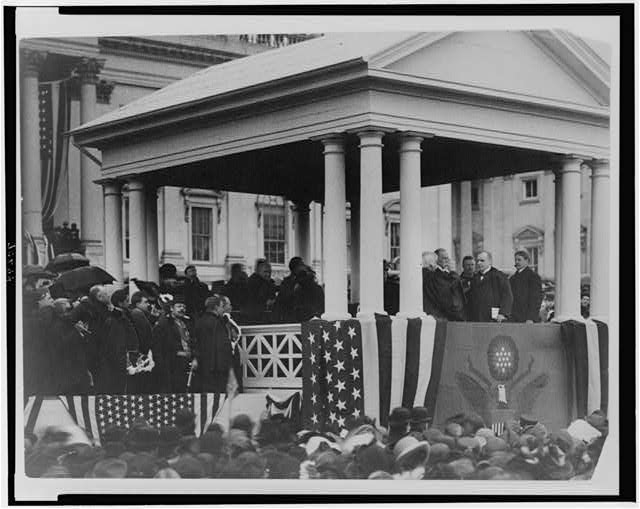
After arriving at the Capitol, the President and President-elect were escorted to the Senate Chamber, while the troops and civic organizations massed in front of the building. The ceremonies attending the administration of the oath of office to the President-elect were under the direction of the Senate. After the conclusion of the inauguration ceremony in the Senate, the President was conducted to his carriage and attended by the guard of honor, who drove him to the reviewing stand erected for the purpose on Pennsylvania Ave north of the White House. If the new President chose to take immediate possession of the White House, the retired President and his First Lady awaited his arrival there to welcome him into the mansion, and formally yielded up its possession. A lunch was usually prepared by the direction of the retired President, at which the new President presides. After this, the retired President and the First Lady withdrew from the mansion to their temporary residence in the city.
President Washington set the precedent for retiring from the Presidential office, when he published a farewell address, reviewing some of features of his administration. It then became customary for the retiring President to review principal acts of his administration in his last annual message to Congress, preceding the expiration of his term of office. His departure from the Capital was attended with no ceremony, other than the members of his late Cabinet and a few officials and personal friends. The President left the Capital as soon as practical after the inauguration.
The excitement of the day didn’t end there. It was customary to close the ceremonies of Inauguration with a grand ball, which was generally conducted under the auspices of a citizens committee of arrangements, appointed at a public meeting. Arousing much comment and curiosity was the costliness of the ball and more importantly, what the new First Lady was to wear. Mrs. McKinley dazzled with a gown made of silver cloth. The groundwork was of white satin, heavily woven with silver thread in a lily design. The full, sweeping train was plain, but measured two and a half yards in length. The left side was open over a panel of seed pearls, embroidered on satin, and at the bottom, a flounce of Venetian point lace cascaded, partially concealed beneath the train. The right side of the skirt was also slashed open half way up and under that was also am embroidered petticoat of pearls. Special silk was woven for Mrs Roosevelt’s inaugural gown, and it was shipped from New Jersey to Washington days before March 4. Of heavy brocade, with a background of blue, through which, at intervals, was woven the figure of a dove. The filling was of gold tinsel. Appropriately, given the occasion and the wearer, the pattern was destroyed, allowing Edith Roosevelt a one-of-a-kind ballgown. 1909 saw Mrs. Helen Taft in “one of the handsomest models ever seen in Washington.” A severely plain underdress of heavy white satin formed the foundation. Over this was draped with white chiffon, on which a pattern of goldenrod, the National flower, was embroidered in silver. The design was repeated in the embroidery of the long Court train, and point lace formed the sleeves and served to trim the decolletage. In her hair was a diamond aigrette, and around her neck, a pearl dog collar.
The inaugural ball was considered by many the quadrennial tribute paid by politics to society. There had only been but two intermission in the series of inaugural balls to commemorate the accession of a newly-elected President. The earlier balls were held on sites then deemed fashionable. Martin Van Buren had two balls given in his honor, William Henry Harrison gave three, James K. Polk had two, one of which was charged $10 a ticket and the other $2, Zachary Taylor had three balls given in his honor, and President Pierce would up being inaugurated in a snowstorm, and had no ball given him. By the 1880s, the Pension Building was staked as the official ballroom for the inauguration ball. Tickets to President Cleveland’s ball cost $5 apiece, and fully 12,000 guests were provided for in the committees plans. The ball was catered to meet vigorous appetites: over 60,000 oysters, 10,000 chicken croquettes, 7,000 sandwiches, 150 gallons of lobster salad, 300 gallons of stewed terrapin, 150 boned turkeys, 300 gallons of chicken salad, 1,300 quarts of ice cream and hundreds of pounds of pate de foie gras.
With all this hustle and bustle, one can imagine the sentiments of the day when President Woodrow Wilson canceled plans for an inaugural ball in 1913. In the midst of societal outrage, the milliners, caterers, dressmakers, tailors, chauffeurs, and any other person who provided services and goods for ball attendees were devastated. The New York Times reported a glut of white gloves on the market, citing their obscenely cheap prices as a result of glovers overstocking their wares in anticipation of the inauguration. After the frenzy died down, it was revealed that President Wilson canceled the ball fearing the dancing of the turkey trot! He instead opted for a safe, turkey-trot-free reception.
Read the Inaugural Addresses of America’s Presidents from George Washington to George W. Bush
Watch:
The Inauguration of President McKinley, 1897
President McKinley’s Second Inauguration, 1901
President Roosevelt’s Inauguration, 1905
First Lady Fashion: 200 Years
Photographs courtesy of Library of Congress
More photos of First Lady inaugural gowns: Past Perfect
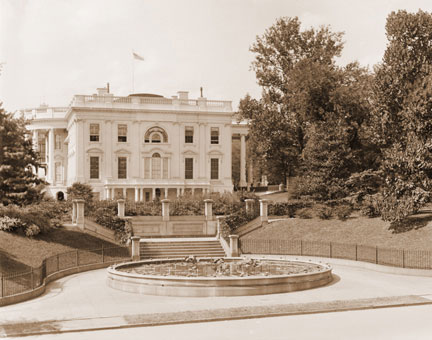
January 1 marked the 208th anniversary of the formal opening of the White House, at Washington, as the official home of the President of the United States. Having taken possession of the newly-built “President’s House” in November of 1800, President John Adams threw an official “housewarming” party for this now most historic and most important dwelling in America. The cornerstone of the President’s House was laid October 13, 1792, and the work was carried on as rapidly as the meager appropriations of Congress could allow. In every decade, and with the incoming of each new President, more and more money was appropriated to run the White House until in 1909, the budget for the White House expenses amounted to an average of $1000 a week (apprx $23,000 in 2008 money).
The source of continual expense was due to mansion being constructed of Virginia freestone, which was exceedingly porous, which needed a thick coat of white lead every ten years to keep the dampness from penetrating to the interior. Because of the cramped space and need for constant maintenance, many historians, and certainly former tenants of the White House, stated that it was not until President Roosevelt remodeled the building that it was made entirely sanitary and healthful.
When he came to office in 1902, President Roosevelt rebuilt the White House practically from scratch, architects considering it “necessary to reconstruct the interior of the White House from basement to attic, in order to secure comfort, safety, and necessary sanitary conditions.” The restoration conformed to the original design, though two wings were added, one being used as the Temporary Executive Offices, and the other for use on social occasions. These changes and improvements were made at a cost of over $600,000 ($12,000,000 in 2008 dollars).
The first tenants of the White House, President and Mrs John Adams immediately required $15,000 ($180,000) to provide furniture, and the first appropriation for repairs was of the same amount but seven years later! Thomas Jefferson had his office outside the White House on the site occupied by the resent Executive offices, and in 1818, Congress appropriated $8,137 ($11,000) for enlarging the offices west of the Presidents House. The South portico was finished subsequent to 1823, at a cost of $19,000 ($325,000); the East Room was finished and furnished for $25,000 ($480,000) in 1826; and three years later, the North Portico was added, in accordance with the original plan, at an expense of $24,769.25. The White House was first lit by gas in 1848, and a system of heating and ventilating was installed in 1853. Four years later the stables and conservatory east of the White House were removed to make room for the extension of the Treasury Building.
How the White House received its name is a source of debate. One source states that Washington so named it in honor of the name born by the home of Martha Washington, while others have it that Martha never lived in a building named the White House, but the name belonged to the home where she and George became engaged. A third source states the house was originally called “The Palace,” but a strong “anti-monarchical sentiment” frowned on this and Congress formally declared it “The Executive Mansion,” and by that name and “The President’s House,” it was known until it was burned by the British in 1814. Then, when its blackened freestone walls were repainted white to hide the traces of the fire, it was rechristened “The White House”.
Though President Washington died before the White House was completed, he left his stamp indelibly upon it. He named the place where the capitol of the United States was to be “District of Columbia” and then a competition was opened to all architects to design the Executive Mansion. The winner was James Hoban, who received $500 ($6000) at first prize, for a design he based on the newly-built mansion of the Duke of Leinster in Dublin, Ireland (Hoban’s native city). When the Adams’ took residence in the mansion, they were less than impressed. The driver, who transported them and their effects from Baltimore, had lost his way, and when they finally arrived in Washington, it was night and the servants could hardly find lights to make the rooms distinguishable. Mrs Adams found them “exceedingly barn-like” in their unfinished and unfurnished state, and they were uncomfortable and cold. By New Year’s of 1801, the downstairs rooms were still unfurnished and unfinished, and Mrs Adams used the East Room in which to dry the household linen and the State parlors were so in name only.
When the mansion was rebuilt in 1814, Hoban was hired for $1600 ($16,000) a year, and Congress voted the sum of $500,000 ($5M) for rebuilding and repairing the public buildings burnt in the fire, with the larger part of the money spent on the Executive Mansion. The first President to live in the rebuilt mansion was James Monroe, who opened his official residence in January 1, 1818. Between then and 1902, the White House was remodeled and repainted and refurnished according to the current Presidents’ tastes and that of his wife’s. When President Roosevelt appropriated some $600,000 ($12M) from Congress, the legendary architectural firm of McKim, Mead and White were placed in charge of the work, with directions to complete the work in four months. They did this ably, and the first official function in the restored White House occurred on December 18, and at the New Year’s reception, Jan 1, 1903, when the new White House was reopened to the public.
In their report, McKim, Mead and White gave the following facts:
“The entire lower floor was used for house service. The principal rooms at the southeast corner were occupied by the laundry; the central rooms on either side of the main corridor were used for heating and mechanical plants; the kitchens occupied the northwest corner; and much of the remainder of this floor was occupied by storerooms and servants’ bedrooms.
Of the floors of the first story, those under the main hall, the private dining room, and pantry, were found to be in good condition. The floor of the State dining-room, while not showing settlement, was so insufficiently supported as to cause the dishes on the sideboards to rattle when the waiters were serving, and the plastering below was badly cracked from excessive vibration. In many places where the plaster was removed, evidence of the fire of 1814 were visible. Also cut into the stonework were found many names, evidently of workmen employed on the construction.
There was scarcely a room in the house in which the plaster was in good condition. In a number of instances as many as five layers of paper were found, and when the paper was removed, the plaster came also. The second floor showed such a degree of settlement as to make an entirely new floor necessary.
The attic, occupied by servants, was reached only by the elevator. The roof drainage had been carried through the roof, and thence on top of the attic floor to central points, descending to the ground through the house itself. The electric wiring was not only old, defective and obsolete, but actually dangerous, as in many places beams and studding were found charred for a considerable distance about the wires where the insulation had completely worn off.
In short, it was necessary to reconstruct the interior of the White House from basement to attic, in order to secure comfort, safety and necessary sanitary conditions. “
When they completed their renovation, the conservatory on the west side was replaced with an esplanade leading to the new Executive Office, and the public entrance was now through a colonnade on the east. This led to the basement corridor, on which walls were hung with portraits of the mistresses of the White House. Broad stairways led to the main corridor, from which access is had to the East Room, and the Blue, Green and Red rooms, which took their name from the color of the decorations and furnishings.
![]() |
The East Room, or State parlor, was used for receptions, and was 40ft wide and 82 ft in length, with a ceiling 22ft high from which dripped three massive crystal chandeliers. The walls were paneled throughout with wood, save for a base of red Numidian marble, the panels being enclosed between pilasters supporting a finely modeled cornice. The decorations of walls and ceiling were white and gold, with moldings and tablet ornamentation in relief, and window draperies of old gold. |
![]() |
The Blue Room, oval in shape, is the President’s reception room. The walls were covered with rich blue corded silk, and the window hangings were blue with golden stars in the upper folds. On the mantle stood the clock of gold presented by Napoleon I to Lafayette, and by him to Washington. |
![]() |
The Green Room, had on the wall green velvet with white enamel wainscoting. In front of the white marble mantel was a screen of old Gobelin tapestry which was presented to Mrs Grant by the Emperor of Austria. A lacquer cabinet was presented to America by Japan in 1858 in honor of the first American ships to enter Japanese ports. |
![]() |
The Red Room walls and window draperies were of red velvet, and a cabinet of mahogany and gold contained seven exquisitely dressed Japanese dolls presented to Mrs Roosevelt by the Japanese Minister. |
![]() |
At the opposite end of the corridor, at the west end of the building, the State Dining Room was paneled in dark English oak, and decorated with the heads of American big game. The white marble mantle was surmounted by an old Flemish tapestry, and the mahogany table seated 100 guests. |
![]() |
The President’s Room and the Cabinet Room were in the Executive Office, west of the White House. |
Upstairs, the old Cabinet Room, which was accessed through the stone stairway near the main entrance of the East Room, was used by President Roosevelt as his workroom. Completing the renovation, all offices on this same floor were transformed into bedrooms for the family, creating a White House which finally served its purpose: a private residence for the President and his family, and a State residence for formal events.
Resources used: Inside History of the White House by Gilson Willets; The Standard Guide of Washingon, 1905 edition; American Estates and Gardens by Barr Ferree. Current money calculations provided by The Inflation Calculator.
For more information:
TR Renovation – White House Museum
The Changing White House – PBS