Archive for June, 2008
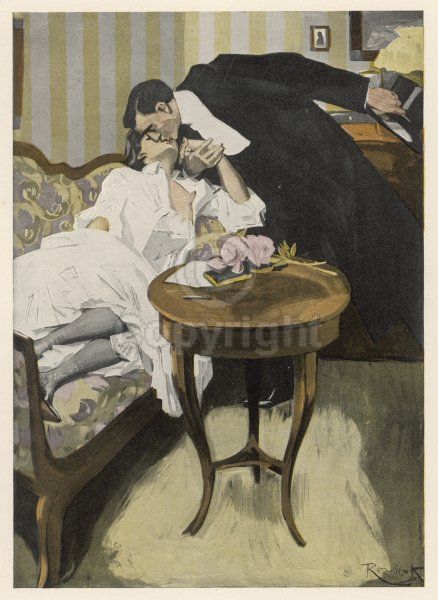
The new silhouette required a much slimmer parcel of undergarments than before, and it was in this period that underclothing took on the sensual connotations of the word “lingerie“. Ornate, overtly sexual and colorful underclothes began to shift away from the boudoirs of courtesans and into the bedchambers of respectable housewives and independent women. Whereas Victorian underclothing had been functional, the sole function of Edwardian underwear was to attract and tantalize men.
Along with the word lingerie used in place of undergarments, other terms changed to reflect the emphasis on seduction; the shift was first called a camisole and then simply known as a “slip” by this period, drawers turning into knickers and petticoats into “frillies“. This was the age of frou-frou, that exciting sound of chiffon and taffeta undergarments that whispered as a woman walked (though by the middle of the era, the sound of a swishing petticoat was deemed vulgar). For the wealthy lady, the proper layer of lingerie was important and the corsetier and couturier one purchased one’s lingerie from was a status symbol, its purchase acknowledging that the lady had a special someone for whom she flaunted her undergarments.
The fashionable woman was poured into at least seven layers of underclothing before she even dressed for the hour! Since they changed clothing five to six times a day, with even more if one was on vacation or at a Saturday-to-Monday, it was imperative that underclothing was both attractive and sturdy. When the lady awoke, her first layer of undergarment were the combinations, a kind of pant and vest in one piece which gained popularity in the 1870s with the introduction of the “Princess style” dress and greatly reduced the bulk that would have accompanied a separate chemise and pantaloons. Generally made of wool or a mixture of wool and silk, they came in a number of styles: strapless for evening wear, or with a skirt in the back to hide the slit in the pants.
Over this was laced the corset. The late Victorian corset fitted over the bosom and hips with curved busks that compressed the stomach and supported the spine, while the S-bend corset of the early Edwardian era, called thus due to the peculiar arch of the back this corset produced,caused women to thrust their bosom forward and their hips backwards to give them the hourglass shape then popular. When skirts and bodices narrowed after 1908, the emphasis was now placed on an overall slimness, and corsets were designed to compress the waist and hips and no longer covered the bosom. They were also quite long, ending at mid-thigh, causing a slight difficulty in sitting and standing.
Next layer, the camisole. A kind of under-blouse that buttoned down the front, it gathered at the waist and was trimmed with lace around the neck and puffed sleeves. This was very fitted, with darts and seaming, and decorated with lace and trimming during the 1880-1908 period, and after, it was made quite plain,often with a square neckline. Over this, a pair of frilly knickers, which sometimes buttoned at the waist or tied with tapes. The last undergarment essential to a lady was the waist-petticoat, made of lawn or rustling silk. It was laid upon the floor in a circle and the lady stepped into the center, the maid lifting the petticoat up and tying it around the waist. Tightly-laced, secured and buttoned up, the lady
was then ready to be attired for whatever occasion of her day or night.
For men, the union suit, a long-time staple of both men (and women until the mid-19th century), was de rigueur. Made of a knitted material,they possessed a flap in the front and the back for necessary needs. The jock-strap was invented in 1874 by a Chicagoan named C.F. Bennett to provide protection when gentlemen rode bicycles. By the end of the 1910s, the union suit was split into upper and lower parts, inventing the undershirt and drawers for men. Soldiers in WWI were issued underwear somewhat similar to the modern-day boxer shorts and due to its popularity, they supplanted the union suit as the mode of men’s underwear.
The history of Greek letter societies in America begins on December 5, 1776, with the founding of The Phi Beta Kappa Society at the College of William and Mary. Its name deriving from the initials of a secret Greek motto, Philosophia Biou Kybernētēs = “Love of learning [is] the guide of life”, the fraternity was a forum for students to discuss topics not covered by their classical education. In addition to its secrecy and selection of a Greek name, it also introduced a code of high ideals, secret rituals and handclasps, membership badges, and oaths that characterized later Greek letter societies. As Phi Beta Kappa developed, it came to become a very influential association of faculty and select students across several colleges, with membership becoming more of an honor and less of a functioning society.
This uniquely North American institution soon flourished and soon, new or auxiliary chapters of existing fraternities were present on nearly all college and university campuses across America. At the same time, sororities (initially called fraternities until the word was used to define Gamma Phi Beta at Syracuse University in 1874) grew from the popular Greek movement, with Kappa Alpha Theta of DuPauw and Kappa Kappa Gamma (both 1870) formally recognized as being the first secret society for collegiate women based on the Greek secret societies for men.
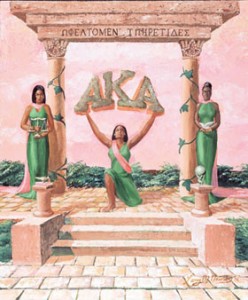
Taking note of this, America’s black educated elite followed suit, and Alpha Phi Alpha became the first intercollegiate Greek letter fraternity established for people of African descent when it chartered a chapter in 1906 at Cornell University. In Spring 1907, Ethel Hedgeman led the efforts to create a sisterhood at Howard University, inspired by the Greek experience of future-husband George Lyle, who was a charter member of Alpha Phi Alpha Fraternity’s Beta chapter at Howard.
Hedgeman recruited any interested ladies and by autumn of that year, Hedgeman and eight other women began to draw plans for the organization. With Hedgeman serving as the temporary chairperson, the women wrote the sorority’s constitution, devised the motto and colors, and named the sorority Alpha Kappa Alpha. In early 1908, seven sophomore honor students expressed interest and were accepted without initiation; however, the first initiation was held in a wing of Miner Hall on Howard University on February 11, 1909.
Alpha Kappa Alpha grew at leaps and bounds at Howard, and
featured a bevy of ritual and sponsored social events. The sorority did hit its first snag, however, in 1912, when twenty-two members were initiated and seven officers were elected. The twenty-two were dismayed at progress and wanted to reorganize the sorority, leading to a split into two factions. The new members wanted to establish a national organization, enlarge the scope of activities of the sorority, change its name and symbols, and be more politically oriented. When Nellie Quander, a graduate member, heard about changing the sorority name, she disagreed and gave the other women a deadline to stop the efforts to reorganize the sorority. However, the twenty-two declined and instead formed Delta Sigma Theta on January 13, 1913.
Quander later revised her opinion, and along with five other sorority members, led an initiative to incorporate Alpha Kappa Alpha Sorority as a perpetual body on January 29, 1913.The organization was nationally incorporated in Washington, D.C., as a non-profit under the name Alpha Kappa Alpha Sorority, Incorporated on January 30, 1913. During the same year the sorority began using Greek names for officers. After this, AKA continued to spread its wings with a second chapter at the University of Chicago in was chartered in fall 1913, with many others following soon after.
In a time when women were marginalized, and women of color were even more so, the ladies of AKA possessed a bravery and courage in their active role in the voting concerns of the day and the support for black rights and education. In addition, Alpha Kappa Alpha helped to support members by providing scholarship funds for school and foreign studies.
After graduating from Howard, Ethel Hedgeman Lyle and the other founding members of AKA continued to be a guiding light to subsequent pledges and members, using their education and social standing to uplift and encourage the lives of black Americans, and uphold the sisterhood, amidst crushing racism and violence practiced against blacks. Today, the sorority boasts a membership of college-trained women around the world, with active members who comprise a diverse constituency, from educators to heads of state, politicians, lawyers, medical professionals, media personalities, and corporate managers, and many chapters, located in the United States, the Caribbean, Canada, Germany, Korea and Japan.
For more information:
Alpha Kappa Alpha (wikipedia)
Official Website
Centenary Celebration
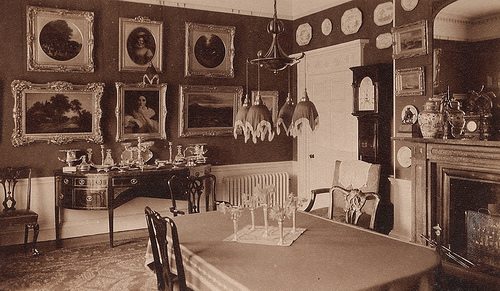
Victorian interior design was characterized by three words: gaudy, ornate and formidable. Following fashion, private and public rooms were stuffed with objets d’art, bric-a-brac, heavy velvet drapery, tables, chairs, paneled walls, Oriental rugs, potted plants, gilded reproductions of Louis XVI furniture—intricately carved, fragile sofas and chairs—Chinese ivory figures, German porcelain vases, ormolu clocks, and miniatures lined the fireplace mantle, the mantle itself shaded by heavy, ornamental fire-shades, and all was overlooked by wall to wall portraits and priceless paintings, richly framed in gold. Rooms in the same house could run the gamut from the “Louis” style so popular with Americans, to the Moorish and Oriental decor transported West by fashionable drapers like Liberty & Co.
Everything and every room were subject to the new tastes in fashion, with housewives frequently gutting their boudoirs, parlors and drawing rooms to redecorate–nothing was sacrosanct when it came to
fashion. But one change did come, a change that rocked the foundations of society and sent clergymen flocking to their pulpits to condemn the new development: the twin bedstead.
When interior decorators made twin beds popular in the 1890′s, some commentators called them a social menace, while others saw them as therapy for an insomniac age. Many were outraged that the firms hired to furbish the homes of the fashionable had dared to breach the bedroom, and proposed to abolish the sacramental double bed and replace it with the new “twin beds” which manufacturers were beginning to introduce. Clergymen and family physicians were drawn into the rapidly bitter domestic controversy, many of the former predicting the breakdown of the holy bonds of marriage by the separation of husband and wife.
However, some physicians asserted that the old-fashioned double bed was unsanitary, and medical journals condemned them vociferously, one writer claiming that injury to one or the other of two people sleeping in this way was sure to result in time: “By the use of the twin bed a married couple could occupy the same room and sleep side by side without harm to either.” The younger generation couldn’t understand the fuss and quickly adopted the new bed, surmising that two steps across the carpeted floor needn’t be an obstacle to bliss.
The twin bed was so designed that when placed side by side, the effect was that of one wide bedstead, with separate spring mattress and bed clothing provided for each one. Many of them were made of costly woods, rich with carving, though a few simpler versions were provided in brass. So ubiquitous was the twin bed, it inspired a number of theatrical and literary farces, and the controversial piece of furniture was soon to be found in college dormitories across the nations. Because of the relative comfort of the bed, and its convenient size, social reformers soon pleaded for employers to grant their servants the use of twin beds; in one home, five servants were all obliged to sleep in one large room in the basement. By the use of single beds two members of the family who occupied separate rooms could be moved into in one, thus providing an extra room to be given up to the servants.
The twin bed found its place in the Code Era of Hollywood, where the Production Code of the 1930s required married couples to sleep in separate beds to uphold the moral codes of the time. Directors got around this with the “one foot” loophole: both stars had to be dressed, and one character had to keep one foot on the floor (check out the bedroom scene in the first Hepburn/Tracy vehicle, Woman of the Year). Ironically, even though people today consider separate beds to be old-fashioned, when physicians recently promoted the benefits of them, it caused just as much furor and controversy as the topic did in the 1890s!