Archive for March, 2008
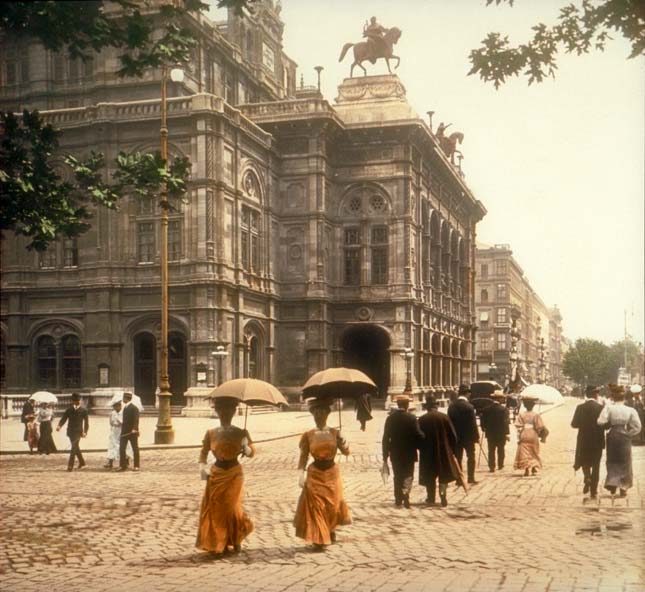
As the boulevards are associated with Paris, Hyde Park with London and Fifth Avenue with New York City, so also is the cafe entwined with the city of Vienna. Such was the renown of the Viennese cafe, Mark Twain was moved to rapture: “that unapproachable luxury–that sumptuous coffee-house, compared with which all European coffee and all American hotel coffee is mere fluid poverty.” The cafe culture of Vienna was such that it replaced the traditional gentlemen’s clubs a good deal, and members of clubs frequented them as much as other men.
According to legend, coffee was introduced to Viennese society after the Ottomans were finally expelled from its gates in the late 17th century. Leaving behind sacks of coffee, a victorious soldier, Georg Franz Kolschitzky was rewarded with them. He discovered coffee by accident, when, during his experimenting with the beans, he accidentally mixed milk with the bitter, black brew. In reality, the cafe culture originated with the Armenian Johannes Diodato, who was awarded for his spying with the monopoly on selling coffee for the period of 20 years. In 1700, four other Armenians named Isaak de Luca, Joseph Devich,
Andre Ben and Philip Rudolf Perg, obtained a license to sell coffee when Diodato was accused of spying for both the Hapsburgs and the Serbians. Cafes were opened in rapid succession. In the year 1714 Vienna had 11 licensed “coffee-houses”, who found a rival in the “waterbrewers” (distillers) who sold coffee without license. In 1747 Empress Maria Theresa effectively ended the quarrel by uniting the two.
By the middle of the 18th Century the basics of the café-tradition had been established. People would meet to read newspapers, play cards, have a game of billiards or just meet friends to chat. By the early 1900s, close to 500 cafes flourished in Vienna. There were so many, it was said every fifth doorway in Vienna admitted one either to an antique shop or a cafe.
Like the English with their five o’clock tea, the social hour of Vienna was 4 o’clock, when the cafes would teem with so many people none but a habitué could obtain a seat. The cafes typically held two kinds of clients: “stammgäste,” or habitué’s, and the “laufende” or transients. The stammgäste, who generally spent from 3 to 4 hours every day at his cafe, were commonly called “wirthausbruder” (cafe brothers), and had tables reserved for them—woe betide any man who ventures to take possession of this sacred property! The coffee house played an important part in all the business ventures organized in Vienna. No business was performed without coffee. When visited by a fellow businessman who had some scheme to propose, they would adjourn to the nearest cafe, order coffee for two, pass a flew pleasant remarks on the weather and compliment each other on one another’s prosperous appearance. When the cups were emptied then the gentlemen took out his dainty cigarette case, offered a cigarette, and they were considered ready to handle business.
The cafe was always full for they were about the only places in the city that were warm. Accordingly, on rainy days the coffee houses were filled all day long. Besides the 4 p.m. rush, the morning hours were also busy, for after breakfast businessmen were wont to drop in at their favorite cafe for an early cup before work. The early part of the evening found few loiters at the small, round tables, but later on, at 11 or 12, the theatergoers began to stream in, to drink and chat until the small hours of the night.
Coffee was served in a variety of manners. Afternoon coffee was of two kinds–either a mixture served with cream, like the French cafe au lait, or a capucin: coffee served without milk. Other varieties which could be ordered were:
Schwarzer. Strong black coffee. A kleiner Schwarzer is the equivalent of an espresso; a grosser Schwarzer is a double shot. Also called a Mokka.
Brauner. Coffee with a dash of milk or cream.
Goldener. Coffee with milk; “regular coffee”
Mélange. Equal amounts of milk and coffee with froth.
Kaffee Crème. Coffee with a miniature pitcher of milk on the side.
Kapuziner. Cappucino.
Verlängter. Coffee with hot water added.
Einspänner. Coffee in a glass with a hefty dollop of Schlagobers or Schlag (whipped cream).
Fiaker. Espresso in a glass with sugar and Kirschwasser (a dry cherry brandy), topped with whipped cream and a cherry.
Pharisäer. Espresso in a glass with sugar, whipped cream, cocoa, and a shot of rum.
The cafe was there to provide much comfort to its patrons. Every cafe subscribed to scores of newspapers and illustrated periodicals in all languages. In the summer the tables and chairs were moved out on the sidewalks, where, at either end were glass sides to protect the tables from the wind and, between the tables and the street, were vines trained in boxes that served to catch the dust of the traffic, and if the sun shone too brightly, an awning was unfurled. Austrian noblemen favored the cafes on the Graben and the Ring, the cafe of the National Hotel was the favorite rendezvous of pleasure seekers (actors, actresses, journalists and cocottes), and the Cafe Daum was renowned for its famous politicians, military aristocrats, statesmen and courtiers. The Hotel Sacher, which, under proprietress Anna Sacher, attracted the international set of socialites, politicians and diplomats met, housed the Cafe Sacher. It was here the Sachertorte was created, and subsequently became a Viennese delicacy.
Other items native to the Viennese cafe were created by German-Austrian furniture maker Michael Thonet. In 1849 he was commissioned by the Cafe Daum to design a coat stand, and the Konsumstuhl Nr. 14, or coffee shop chair no. 14, created in 1859, won a gold medal at the 1867 Paris World’s Fair. The unique technology of wood bending heated by steam made it one of the best-selling chairs ever designed. Made of six pieces of steam-bent wood, ten screws, and two nuts it could be taken apart easily. The seat would often be made out of woven cane/palm, because as this was a cafe chair the holes in the chair would let spilt liquid drain off the chair. So popular was this chair that over 15 million were sold between 1860 and 1930.
Further Reading:
Uncommon Grounds: The History of Coffee and How It Transformed Our World by Mark Pendergrast
The Devil’s Cup: A History of the World According to Coffee by Stewart Lee Allen
The Coffee House: A Cultural History by Markman Ellis
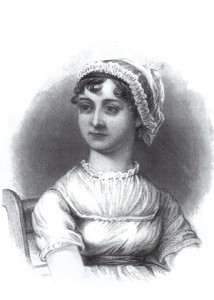
Ah Jane Austen! It is apparent that she shall never go out of style, as witnessed by the many TV & movie adaptations and novels inspired by her life and works. But the obsession with all things Austen goes much farther back than spate of movies released in the 1990s.
The “cult” of Jane Austen finds its origins in 1870 with the publication of a memoir written by her nephew James Edward Austen-Leigh. In doing so, he “sentimentalized his aunt to make her conform to Victorian values, which had become more rigid and repressive by mid-century, so that she would not offend Victorian sensibilities.” As a result, many contemporary authors praised her novels and their endorsements propelled Jane Austen into the spotlight.However there were her detractors (as there are today, as I have found, having stumbled upon a facebook group dedicated to their hatred of her works–it is telling that the majority of its members are men).
Mark Twain held her works in revulsion, stating: “Jane Austen? Why, I go so far as to say that any library is a good library that does not contain a volume by Jane Austen. Even if it contains no other book.”
But Rudyard Kipling demurred, writing a short story entitled “The Janeites“, in which a group of English soldiers in WWI who formed a “shadow Masonic lodge based on their deep admiration and extensive knowledge of Jane Austen’s novels, which are a source of consolation and support as they undergo the horrors of World War I trench warfare.” By the 1890s, the popularity of Jane Austen and her novels was such that it “resulted in no less than ten new editions of her novels in less than a decade and three memoirs by different hands within as many years”.
Another aspect of the craze for Jane Austen’s novels were found in the memoirs of Lady Diana Manners, in which she states that in her debut Season in 1911:
“with all the lunches, dinners, theatres, and balls of the forthcoming month, she would be writing at least five ‘Collinses’ a day. These thank-you notes, requiring extensive consultation of a recognized dictionary in order to make them sufficiently original, accurate and ingratiating, took their nickname from the obsequious gratitude that flowed from the pen of Mr. Collins in Pride & Prejudice.”
Coincidentally, the 1910s saw a revival of the “Directoire” or Empire style of the early nineteenth century, with
high-waists, slim silhouettes and the popularity of turbans and other Oriental inspired clothing.
1938 saw the first documented cinema adaptation of one of her novels, being–you guessed it–Pride & Prejudice. This was followed by a watershed of adaptations for TV and the motion picture industry, and one that continues today with the BBC’s recent “Jane Austen Season” (aired in America January 2008) and the recently released Becoming Jane.
With love and marriage, there can unfortunately be divorce. For our Edwardian counterparts, divorce was a difficult and arduous process that could be, depending upon the social circle, a one-way ticket to the cut direct.
The law of England regarded marriage as a contract, a status and institution. Up until 1857, divorce was administered by ecclesiastical courts, who created
such a long, frustrating and expensive route to end a marriage, most unhappy couples had no choice but to remain together. Upon the passing of the controversial Divorce Act of 1857, the jurisdiction was passed from the ecclesiastical courts to a new civil tribunal, and absolute divorce was sanctioned with permission of remarriage on proof of adultery on the part of the wife, or adultery and cruelty on the part of the husband.
For the miserable couple willing to weather the scandal and the exclusion from the choicest circles, if not the still considerable expense, the application for divorce would be made by a petition to the Probate Divorce and Division of the Court of Justice. The party seeking relief was called the “petitioner” and the party against whom the petition is brought was called the “respondent“. If the wife was accused of adultery, the party with whom she committed this “criminal act” was the “co-respondent.” However, the person with whom the wife alleged her husband had committed adultery was not a party to the suit–but a woman implicated in a divorce suit could, upon proper application, be allowed to secure an order permitting her to attend the proceedings as an “intervener.”
While a husband was entitled to a divorce if his wife committed adultery, a wife had to jump through hoops. Besides adultery, a husband had to commit incestuous adultery, bigamy, rape, sodomy, bestiality, adultery coupled with cruelty, or adultery coupled with desertion without reasonable excuse for two years or more. Incestuous adultery was adultery with a woman within the prohibited degrees (sister, grandmother, mother-in-law, etc). Furthermore, a wife would not be granted a degree of divorce on the grounds of cruelty and adultery, unless the cruelty consisted of bodily hurt or injury to health, and at least two acts of cruelty on the party of the husband were required. Thankfully (in this instance at least), the communication of venereal disease when the husband knew of his condition was considered an act of cruelty.
Barring condonation (where a matrimonial offense, which is a sufficient cause for divorce, is condoned or forgiven by the spouse aggrieved), connivance (where the adultery complained of was committed by the connivance or active consent of the petitioner) or collusion (the illegal agreement and co-operation between the petitioner and the respondent in a divorce action to obtain a judicial dissolution of the marriage), the couple was on its way to receiving a decree nisi. If, after six months, it was unaffected by any intervention by the King’s Proctor or any other person it could be made decree absolute upon proper application.
For the gentleman or lady who desired lose an undesirable spouse, there was no greater a solicitor than Sir George Lewis of Ely Place, Holburn. Described by contemporary portraits as a “pleasant-voiced, white-haired, dapper little man” who was the “depository of so many scandalous secrets,” it was he who helped society’s brightest extricate themselves from sticky situations–such as the time when Lady Charles Beresford attempted to blackmail the Countess of Warwick into breaking off her relations with Lord Charles, and Lady Warwick brought in the Prince of Wales to back her up.
The divorce court itself was a source of entertainment. On almost any day, particularly if a scandalous case was being tried, a line some fifty or sixty people deep, made mostly of women, queued up at Royal Courts of Justice the for a seat in the public gallery. This was a considerable annoyance to junior barristers, who, especially when an aristocratic trial brought a crush, were perpetually unable to find a sufficient number of seats.
Despite collusion nullifying a petition for divorce, it was a standard procedure for couples who just couldn’t stand one another. To spare the wife even greater scandal, she would hire a private detective to follow her husband on an appointed night, the husband himself having hired a lady to impersonate his lover, and there would be proof of adultery. On the other hand, a wife could publicly refuse to share her husband’s bed, and he could sue for divorce based on her repudiation of his conjugal rights. If divorce was unobtainable, a couple could petition for a legal separation, which was easier to receive, but the prospect of a future divorce was made a bit more difficult.
The most difficult part of an English divorce were the children. Unlike in France or America,
where children of divorced parents lost nothing and were at liberty to watch over their bringing-up, according to English law, a guilty mother was entirely deprived of their custody and even access (however, it was allowed for a faithless father). Under no circumstances, if the mother was found guilty, would she have custody of the children regardless of their ages. In divorce, the guilty woman lost everything: income, custody and access to children, reputation, and even in some cases her husband’s name.
Sources:
Thirty-five Years in the Divorce Court by Henry Edwin Fenn
Inside the Victorian Home: A Portrait of Domestic Life in Victorian England by Judith Flanders
The Eighth Year by Phillip Gibbs
Edwardian Stories of Divorce by Janice Hubbard Harris
Marriage and Divorce Laws of the World by Hyacinthe Ringrose
There arose in the 1880s, the phenomena of the “professional beauty.” A curious phase had come over society wherein publicity became the fashion, and from it, the craze to exhibit photographs of “Ladies of Quality” in the windows of Fleet Street. Instrumental in creating this sensation was London-based artist Frank Miles, who specialized in watercolors of society women, and Lillie Langtry.
Born on the Isle of Jersey, she arrived in London in the mid-1870s with her alcoholic husband Edward Langtry and promptly entered society despite having little money. While her beauty at first created a mild interest, it was her attendance of social events clad in the same black dress that created a stir. When someone finally commented on her continuous use of that dress, she arrived at her next engagement wearing a white dress of similar fashion. This provocation created a furor and suddenly, artists wanted to paint her, hostesses vied to have her on their guest lists, and people (even the most fearsome dowagers!) even stood on benches in Hyde Park, or chairs at balls, to catch a glimpse of her. So great was her fame that her greatest wish–to be presented to Queen Victoria–was granted (some say at the instigation of the queen herself!). Coached by the highest in the land (the Prince of Wales, soon her lover), the wittiest (Oscar Wilde), and the most talented (James MacNeil Whistler), she cut a swath through aristocratic society. Frank Miles, one Lillie’s earliest acquaintances, capitalized on the increasing voraciousness of people for pictures of society beauties, and these women, subsequently dubbed “Professional Beauties” or, P.B.’s for short, took not only London at large by storm, but the known world.
Just about any beautiful woman could become a professional beauty–not through success at court, but in the emerging celebrity culture associated with illustrated periodicals and mass-circulated photographs. The professional beauty needed not be rich, highly born, nor well educated–provided she had sense enough to escape from committing any glaring missteps–all that was required of her was that her face should be approved by society as a great beauty and her future was assured. Recognition as a P.B. was reward in itself. Reproductions of the beauties appeared in every store window and hung in every middle-class dwelling. The originals graced the mansions of wealthy patrons of the arts. Queen Victoria ‘s youngest son, Prince Leopold, became so enamored of a pen-and-ink sketch of Lillie Langtry he had seen while visiting Miles’s studio that he acquired it to hang in his bedchamber – until his mother snatched it down.
Women of superior social stations inundated the P.B. with cards for dinners and receptions; for a time no party was considered complete or successful without these ladies. People would receive invitations with “Do come, the P.B. s will be there,” and this meant the certain attendance of society. Artists vied with each other in inviting her to their studios in the hope that they would be permitted to paint or sketch her. The professional beauty need never purchase clothing or accessories again; all that was required of her was the murmur of her couturier’s or milliner’s names to guarantee instant success of that artist of fashion. “She was worth – literally – 100 paying customers. She was a walking – no a gliding – advertisement.”
In London, the professional beauty was queen. Not a ball was considered a success without her presence. At dinner she eclipsed rank wealth and fame and was the object of attentions which would be flattering were they less curious and obtrusive. Should she ride in the Row a little cavalcade accompanied her, which only quit her presence when some very distinguished personage came up to canter by her side. At a country house party, no matter who may be the visiting, she was always the most favored of guests. So firmly did the professional beauty rule society that her word was law and her wishes commanded the amusement of the hour: If she voted guessing acrostics dull, acrostics were abandoned. If she was fond of hunting, the best and safest of mounts that the stables possessed were placed at her disposal, whilst the most sober and careful of grooms was to specially attend upon her and to see that her exquisite beauty should not for a moment be in danger.
A fierce war of opinion as to their rival merits raged about them. Artists extolled Mrs. Langtry’s classical Greek profile golden hair and wonderful column-like throat, graced with the three plis de Venus, which made her an ideal subject for their brushes and chisels. Poems were written in celebration of the professional beauty, one of which was saved by Lady Randolph Churchill, herself a professional beauty:
First Lady Dudley did my sense enthral,
Whiter than chisel’d marble standing there,
The Juno of our earth “divinely tall,
And most divinely fair.”And next with all her wealth of hair unroll’d,
Was Lady Mandeville bright eyed and witty;
And Miss Yznaga whose dark cheek recall’d
Lord Byron’s Spanish ditty.The Lady Castlereagh held court near by,
A very Venus goddess fair of love,
And Lady Florence Chaplin nestled nigh,
Gentle as Venus doveAs gipsy dark with black eyes like sloes,
A foil for Violet Lindsay sweetly fair,
Stood Mrs Murietta a red rose,
Was blushing in her hair.And warmly beautiful like sun at noon,
Glowed with love’s flames our dear Princess Louise,
Attended by the beautiful Sassoon,
The charming Viennese!Then Lady Randolph Churchill, whose sweet tones
Make her the Saint Cecilia of the day;
And next those fay-like girls, the Livingstones,
Girofla Giroflé!And then my eyes were moved to gaze upon
The phantom like celestial form and face
Of the ethereal Lady Clarendon,
The loveliest of her raceThe beauteous sister of a Countess fair,
Is she the next that my whole soul absorbs,
A model she for Phidias, I declare,
The classic Lady Forbes
Other preeminent professional beauties were Lady Lonsdale (afterwards Lady de Grey), Lady Brooke (later Lady Warwick), the Duchess of Leinster and her sister Lady Helen Vincent, Lady Londonderry, Lady Dalhousie, Lady Ormonde, Lady Mary Mill, Lady Gerard, Mrs. Luke Wheeler, who always “appeared in black,” and Mrs. Cornwallis West, the mother of Lady Randolph Churchill’s much younger second husband.
Accordingly, and some say, obviously, many of these women reigned briefly as the Prince of Wales’s mistress. In direct contrast to these London beauties, the professional beauties of Paris were not ranked or cataloged. They did not have their portraits published in the illustrated papers nor did they allow their photographs to be sold at the stationers. However there always existed a little staff of about twenty women who represented grace, beauty and Parisian elegance.
But one Parisian hostess did break the mold: Virginie Amélie Gautreau, who is better known to history as the subject of John Singer Sargent’s “Portrait of Madame X.” An American expatriate married to a wealthy French banker, when her painting was revealed in the Paris Salon of 1884, it caused a scandal. Already trailed by whispers of fast behavior, the portrait as painted, was of a sexually-aggressive woman clad in a figure-hugging black gown whose right strap had fallen–a hint that with “one more struggle“, wrote a critic in Le Figaro, “...the lady will be free“. Amidst the outrage and ruination of his career, Sargent painted over the strap to secure it on Madame Gautreau’s shoulder and concealed the painting for over thirty years. As for the lady, her reputation was destroyed and she passed the remaining years of her life alternately attempting to recapture her fame and escaping the realities of time by avoiding mirrors.
The professional beauty’s American counterpart was found in the “Gibson Girl” of the 1890s and 1900s, as created by Charles Dana Gibson. The Gibson Girl set the first national standard for a feminine beauty ideal: “She was taller than the other women currently seen in the pages of magazines.. infinitely more spirited and independent, yet altogether feminine. She appeared in a stiff shirtwaist, her soft hair piled into a chignon, topped by a big plumed hat. Her flowing skirt was hiked up in back with just a hint of a bustle. She was poised and patrician. Though always well bred, there often lurked a flash of mischief in her eyes.”
The Gibson Girl appeared on saucers, ashtrays, tablecloths, pillow covers, chair covers, souvenir spoons, screens, fans, umbrella stands and was personified by Gibson’s wife, Irene Langhorne, Evelyn Nesbit and the Danish-American stage actress, Camille Clifford, whose towering coiffure and long, elegant gowns wrapped around her hourglass figure and tightly corseted wasp waist defined the style. Depicted as an equal and sometimes teasing companion to men, the Gibson Girl was provocative and independent, perfectly expressing the cool exuberance of the turn-of-the-century American lady.
The life of a professional beauty could be wonderful, exhilarating and fun, but only on the condition that she remained beautiful and charming, had not a hairsbreadth of scandal attached to her name, and could financially maintain her socializing. This was near impossible not only because of her attachment to the spendthrift and frivolous Marlborough House Set, but also the passing of time. Lillie Langtry fell from grace when she bore a child out of wedlock, and only recaptured a bit of her fascination by becoming a moderately talented actress. Even aristocratic women found it difficult to escape the fate of chance: Lady Randolph Churchill was plagued with money troubles all of her life and Daisy Warwick, her family fortune run dry by the 1910s, attempted to blackmail George V into granting her renumeration for her amusement of his deceased father by threatening to publish the letters he exchanged with her during their relationship.
Truly only a step above a courtesan, the professional beauty was protected from scandal and the taint of sexual immorality by her rank and marriage. But in a time where women could be considered property (though this lessened considerably by the 1880s in comparison to earlier eras), and her social roles were defined and the boundaries between “public” and “private” were beginning to blur, the P.B. could essentially have the best of both worlds: the fame and fascination of an actress and the venerated social status of an aristocrat.
Sources:
Days I Knew by Lillie Langtry
The Reminiscences of Lady Randolph Churchill by Mrs. George Cornwallis-West
The Edwardian Woman by Duncan Crow
Strapless: John Singer Sargent and the Fall of Madame X by Deborah Davis
London Society by eds Hogg, James and Marryat, Florence.
Edward and the Edwardians by Philippe Jullian