Archive for February, 2008
The silhouette of the Edwardian woman changed drastically between the 1880s and the start of WWI. From the protruding bustle of the 1880s and the aggressive, slightly masculine leg-o’mutton sleeves of the 1890s, to the S-bend, swan-like shape of the 1900s and the ultra-slim line of the hobble-skirt in 1910, each reflected the shift of the roles women played in society. The “New Woman” of the 1890s was the natural reaction to the 1870s and 1880s, when not only were white-collar jobs increasingly available to them, but universities began to open their classes–or, in the case of Oxford and Cambridge–opened colleges for the education of women.
The popularity of the bicycle, which enabled women much more freedom (and also brought about the grudging acceptance of the bloomer) from chaperonage and from past restrictions concerning their contact with places outside of the home. While ridiculous to modern eyes, the exaggeratedly puffed sleeves of the 1890s are said to be a metaphor for the aggressiveness of women, who played just as skillfully and competitively as their male counterparts in such sports as fencing, croquet, law tennis and hockey. To the older generation, the”New Woman,” who rode her bicycle to and fro, met single men for tea in the newfangled tea-rooms, attended college and–gasp–might have smoked (and all of it unchaperoned) was a shock to the systems–systems, for those who survived into the first decade of the 20th century, would suffer more shocks.
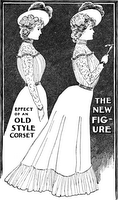
For a brief period at the turn of the century, fashions reverted to the overly feminine: pastel colors and the languid silhouette of the “S”-bend corset. Surprisingly, the S-bend corset (termed such, for it thrust the bosom forward and the derrière backward, causing the posture to bend) was invented by a female doctor as a health corset that fit beneath the bust and allowed for freer movement. Obstinate against their bodies being, in a sense, corset-less, women adapted this corset into its familiar usage. Starting around 1908, with the staggering width of hats, skirts began to narrow and the Directoire style arrived–an adaption of the empire waists and flowing skirts of the Regency era–, and corsets began to lengthen and straighten, starting just above the waist and fitting well down the thighs, thereby making sitting quite difficult.
Ironically(or not), with the rising militancy of suffragists, skirts began to narrow until they became the barreled, banded style known as the hobble skirt. From 1911-1912, skirts became so narrow they hampered the movement of women, causing them a
variety of problems that required the assistance of gentlemen for the most simplest of tasks. After that brief, brief period, hobble skirts began to feature discreet slits and panels, an accomodation which coincided with startling popularity of the Argentine tango. Hemlines also began their discreet rise, hitting the tops of boots by 1913, and rising eight inches from the ground by 1917. Oddly enough, despite the fabric shortages caused by WWI, skirts were wide and full during the war years, slimming down by 1918 and slowly morphing into the knee-skimming styles we identify with the 1920s.
To dress the actual Edwardian lady was a daunting task in and of itself. “‘…. A large fraction of our time was spent in changing our clothes.” said Cynthia Asquith. From Lady Randolph Churchill to Consuelo Vanderbilt to Lady Diana Manners , copious memoirs written by the period’s luminaries all described this phenomenon. It wasn’t enough to keep up with the fashions, one had to carry them off with style and aplomb–and the quintessential Edwardian lady, tall, stately and beautiful, was the perfect canvas for the artistry of Worth, Doucet, Beer, Callot Soeurs, and Paquin.
A typical Saturday-to-Monday would require at least half a dozen changes of clothes: tweeds for shooting, habits for hunting, tea gowns for lounging, day dresses for day, evening gowns for supper, walking dress for promenading, and the requisite “tailor-made,” a suit of varying fabrics–depending on the occasion–, worn with shirtwaist, designed by the House of Redfern. Alongside these articles of clothing came sportswear, outerwear (mantelets, coats, jackets, pelisses), gloves, handbags, shoes, boots, parasols, brollies, and most importantly, hats.
The bonnet disappeared in the 1890s, and hats gradually grew wider as the era progressed, the “Merry Widow” hat of 1907-08 retaining its popularity until 1914. Onto these hats were piled masses and masses of flowers, netting, feathers, and sometimes, birds. It was not atypical for a lady to not have an elaborately-made hat with perhaps a stuffed pigeon–shot by her husband or an admirer–perched saucily between feathers. The craze for feathers got so bad, laws began to be passed restricting the use of certain types of bird’s feathers. All of this, besides hats, who were placed in hat boxes, would be packed into a trunk colloquially called a “Noah’s Ark.”
Articles of clothing themselves were as elaborate on the inside as they were without. Snaps and tapes fastened the blouse at either center back or the side and it was then hooked to the back of the skirt to combat gaping when the arms were lifted. These blouses, made of “soft clinging fabrics, with wilting sleeves dripping with expensive lace”, were elaborate and sometimes seductive confections of lace, ribbons and chiffon. The aptly titled “pneumonia blouse”, was a sheer, near transparent V-necked blouse that tantalized and hinted at the delicate skin hidden beneath. The skirts themselves were of languid and elegant gored lines, inspiring such names as “mermaid”, “eel” or “umbrella” skirt. Covering the blouse with a beaded and beribboned bolero jacket, sliding into slender Louis heels, and topping off with a wide hat, the Edwardian lady was dressed for the most simplest of that day’s tasks.
Further Reading:
Handbook of English costume in the nineteenth century by C. Willett Cunnington
Handbook of English Costume in the 20th Century 1900-1950 by Alan Mansfield and Phillis Cunnington
Victorian and Edwardian Fashions from “La Mode Illustree” by JoAnne Olian
The ritual of taking tea in the “afternoon” (really, early evening, around four to five o’clock) conjures images of polite, white-gloved ladies gossiping over cups of steaming Oolong or Darjeeling. The ritual was established in the 1840s by the 7th Duchess of Bedford, who, finding herself famished between dinner and supper, “ordered a small meal of bread, butter, and other niceties, such as cakes, tarts, and biscuits, to be brought secretly to her boudoir. When she was exposed she was not ridiculed, as she had feared, but her habit caught on and the concept of a small meal, of niceties and perhaps tea, became popular and eventually known as ‘afternoon tea’.” As the century progressed, and cosmopolitan, aristocratic circles began to pattern itself after the Prince of Wales, the ritual of the afternoon tea began to be associated with more erotic elements, in the guise of the tea gown.
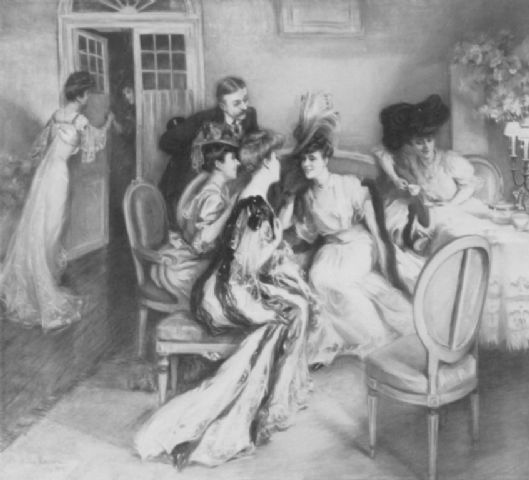
Alternately known as a “tea gown”, “robe d’interieur”, or as fashionable Edwardian society christened it, “teagie”, this article of clothing was, above all things, an indoor dress–as its name implies. A natural cousin to the dressing gown and the peignoir, both of which existed prior to the Edwardian era, the tea gown developed in the 1870s, when both day and evening dresses were tightly fitted. Enabling the Edwardian lady a chance to relax from the bustles and corsets of the day in the company of her associates, it was inevitable that the garment’s relative ease of fastening would prove itself the natural to the setting of seduction. Afternoon tea then morphed into what the French called “le fif-o’-clock” or “four to five”: the accepted time when a lady could entertain her lover with the tacit understanding of her husband. Said spouse would not enter the drawing room at that hour (and in fact, was most likely meeting his own lover), and with the collusion of discreet servants, the lady would announce herself “at home” to no one but her gentleman caller.
The gown itself, despite its naughty connotations, soon became a necessary part of a lady’s wardrobe, fashion writers of the day declaring that “no season’s outfit is considered complete without an assortment of tea gowns, and upon this costume designed and intended on for the most informal wear is expended more time and forethought and planning, that it may be perfect to the most minute detail, than is often given to a velvet reception gown or a satin ball dress.” Because of the gown’s marriage of both comfort and style, the costume moved also into the evening, a dinner tea gown, this version lower at the décolletage and made more elaborately, with somewhat the effect of a fitted gown with a loose cape of lace or chiffon worn over it. The train was longer and the sleeves shorter, and this gown is so made as to be suitable for an informal home dinner of not more than six persons, and was not meant to be worn outside one’s own house.
Of the afternoon tea gown, it was generally made with a transparent yoke of lace or chiffon, collarless and preferably slightly V-shaped. Soft silks and satins and penne and chiffon velvets were principally used for the afternoon tea gown, but chiffon, chiffon clothes, marquisette and lace were to be seen. By 1908, the tea gown was made in two parts, but instead of having waist and skirt separate, this part of the dress was all in one, while over it was slipped a loose coat or tunic of lace or chiffon transparent so as to leave visible the natural waistline. “The under part of the dress was composed of the skirt, which is generally elaborately flounced and trimmed, and a bodice made of the same material as the dress, but absolutely plain with ribbon or satin shoulder straps to keep the dress in place. The lace coats are apt to be the most effective if allowed to fall almost to the hem of the gown itself, the delicate shade of the silk or chiffon showing through the work of the lace with charming effect. A few of the tunics are of lace dyed the color of the chiffon or silk.”
A less romantic view was taken of this gown by French fashion writer, Baroness d’Orchamps, who suggested the tea-gown be worn for “messy chores or for visits to the kitchen.” Used for this sort of task, the gown would be made in wool, flannel, or broadcloth. But of course, this line of advice was ignored by the fashionable. The tea gown was suited to be an indoor garment, “born of fantasy,” and an original creation that was intended to express the wearer’s intimate tastes, while at the same time flattering to her beauty.
Further Reading:
The Book of Afternoon Tea by Lesley Mackley
To the Edwardians, everything had its place, and most importantly, everyone. For a society now transformed by the influx of wealth-sans-birth, a set rules were created to show who was in, and to keep others out. Prior to the Victorian era, Britain’s ruling class of the eighteenth and early nineteenth centuries were composed of scarcely more than three or four hundred families, whose wealth and power stemmed virtually, with no exceptions, from land. By the end of the nineteenth century, these three or four hundred families had expanded tenfold and Society was alternately termed the “Upper Ten Thousand.” The main contributor to this drastic change were the increasing numbers of self-made millionaires and the declining values of land. The Reform Act of 1832, which abolished “rotten boroughs” and enabled the middle-classes and nouveaux riche the opportunity to rise in status as an MP, further contributed to the expansion of society. Thus, the newly elected MP and his family, energetically climbing the social ladder, needed guidance for behavior.
After the ascension of Queen Victoria, “gentility” was the accepted norm for social behavior not only for the middle-classes, but also the upper-classes. Outside of a few rebels (either left over from the wild Regency era, like Lady Blessington, or foreigners, like Louisa von Alten, 7th Duchess of Manchester), the first two or three decades of the Victorian era cultivated propriety and exclusiveness. To contain society against the social climbers, the card-and-call system was created. This system provided assurance that if your domestic and sexual reputation were unassailable, and your income above a certain level, you were permitted entry into a group of acquaintances with whom you could mix freely without feelings of social unease or constraint.
According to Lady Colin Campbell, you could not “invite people to your home, however often you may have met them elsewhere, until you have first called upon them in a formal manner and they have returned the visit.” The first step in the call-and-card system was to obtain calling cards. Previous generations brandished important-looking, ostentatious cards of very stiff, very highly-glazed vellum, with their names written in a series of flourishes. By the 1890s, cards had grown plainer, the gentleman’s name smaller than the lady’s, with name and address printed in an ordinary style. Married couples often had their names together on one card:

While unmarried daughters had their names place beneath that of their mother’s:

The method of calls varied, depending upon the occasion, but the typical call—the “calls general”—entailed the leaving of cards in the home of a prospective acquaintance. After an introduction was been made through a mutual friend, a formal visit was expected to be returned within three or four days. After receiving any particular hospitality such as a dinner or ball, it was necessary to call, or merely to leave cards at the door, within the few following days. The hours for calling were strictly confined between three and six o’clock p.m. For an acquaintance to call before luncheon would be the grossest presumption.
In regard to the calling cards, a lady left her own and two of her husband’s, one intended for the gentleman of the house and the other for the lady (meaning, the lady of the house would be given cards from both the caller and the caller’s husband). When leaving her husband’s cards, they would be placed on the hall table, and should the lady of the house be absent when one called, one corner of the card was to be turned down, which signified that one has called personally. The formal “morning” call was the follow-up to the card. Together, they indicated that a state of friendship existed between the two parties concerned, ready to be built upon as might seem convenient or pleasurable. However, if a call was followed by a card, it was a snub and obviously indicated that the lady had reached too high above her.
If a lady progressed past the stage of leaving cards and was invited to an “At Home,” the pressure had increased. Not only was she on display for the hostess, but most likely, the hostess’s own social circle, which meant she had to please and impress everyone. Furthermore, she had only fifteen minutes in which to do it. When she arrived at the house, she gave her card to her footman, who then handed it in at the door. If the mistress was willing to receive guests, the lady would enter the house and be led to the drawing room, where she would be introduced and promptly seated in the nearest vacant chair to her hostess. The question uppermost in the minds of the hostess and her friends was whether the newcomer make people feel awkward. Things that could create awkwardness included a lack of required family background, a lack of wealth (though a good background made up for poverty), a lack of assurance, lack of an acceptable moral reputation, and most important, the lack of ability to conform to the group’s social demands.
To be truly accepted into the new circle, the lady had to prove that she lacked nothing in all five respects; to fail one prerequisite would mark oneself as a red-flag that the quiet drawing-room could suddenly fall into chaos. However, since her very presence indicated a modicum of acceptance, there as another hurdle to leap over: was her voice pleasant; how did she speak (did she say “father,” rather than the correct “my father”); did she gush; did she wear the right clothing for the occasion; did she flutter and keep gestures to a minimum; and above all, did she carry herself with a poise the proclaims her a potential member of the circle as of right?
If the lady impressed the hostess and her friends, further calls were made and returned, and soon, the hostess’s card became a familiar sight in the lady’s card-basket as she was slowly absorbed into the circle. The hostess’s friends also initiated card-and-call moves of their own. The one invitation to tea was followed by another. Perhaps an invitation to a ball. A visit in an opera box. Then—triumph—there was an invitation to a dinner party!
Further Reading:
The Model Wife: 19th Century Style by Rona Randall
The Social Calendar by Anna Sproule
Etiquette of Good Society by Lady Colin Campbell