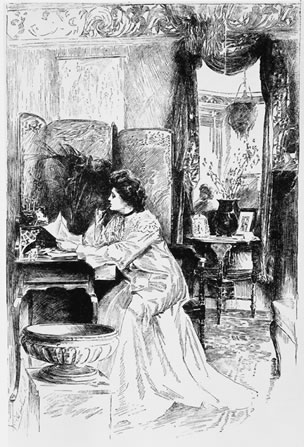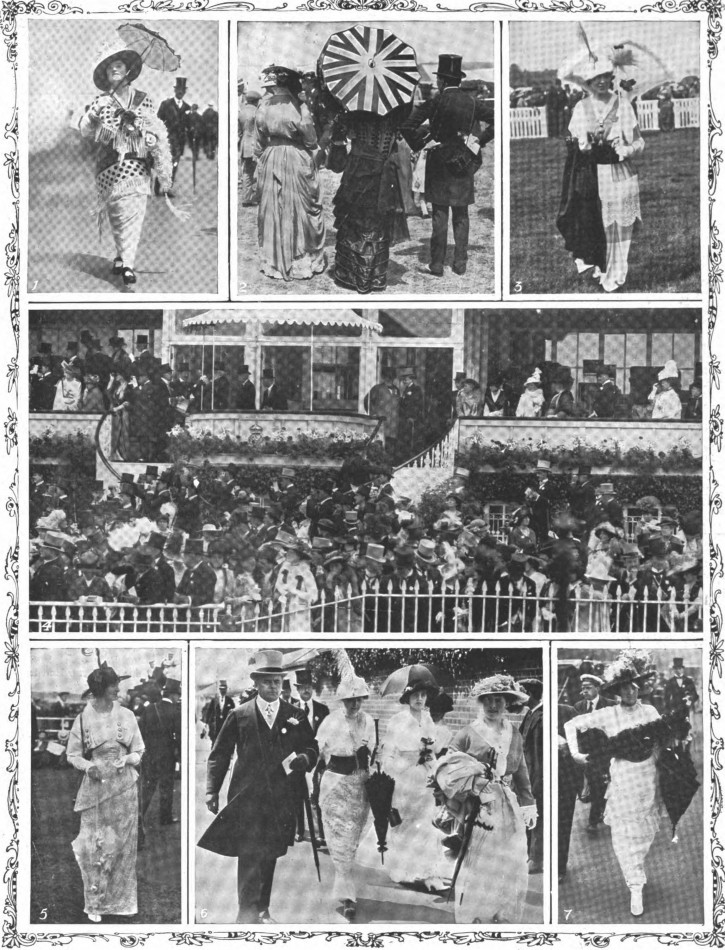


The Parisian Woman at Her Toilet

The life of a Parisian élégante is far from being an idle one; it is, on the contrary, a prodigiously active and frightfully exhausting life, which no one can lead with success who is not endowed with executive ability and great nervous endurance.

The cares of the toilette, the daily succession of visits, receptions and fetes, the theatres, the flower and picture shows, races, lectures, attendance at church, with many other duties and pleasures, form a cycle absorbing every hour and moment of this rushing, fluttering, froufroutante existence.

In short, a Parisian woman of fashion lives in a perpetual whirl, which allows her no graceful intervals of leisure in which to retire within herself and indulge in dreams arid reverie. Dress alone constitutes an intolerable tyranny—one, however, to which she slavishly submits. The morning toilette, to begin with, involves the torment of the hairdresser and the manicure, and for many the torment of “making up” the complexion, of massage of the head at intervals (a long and fatiguing process), and of face-massage for her who trembles at the sight of her first wrinkle.

The Colour of Paris: Historic, Personal & Local by Lucien Descaves

The Parisian woman at her toilet

The Parisian woman at her toilet

The Parisian woman at her toilet

The Parisian woman at her toilet

The Parisian woman at her toilet

The Parisian woman at her toilet

The Parisian woman at her toilet

The Parisian woman at her toilet

– Photos from German periodical, Das Album, April 1899 (via Wikimedia Commons)

Posted in Beauty | Tagged , , , , , | 5 Comments

The Inner Life of a Gentleman’s Club

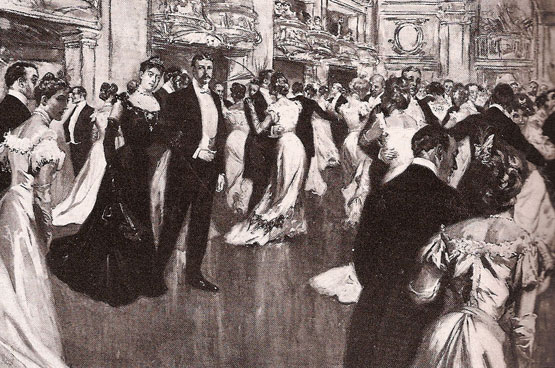
Gentleman's club, 1906

[T]he day at a club begins the night before. About 9 p.m., when the rush is over, the chef or chief cook takes stock of what is left on hand, and frames his estimate of what will be required for next day’s consumption. His calculation is based upon the season of the year and the average number of members using the club at the time, from which he arrives at the probable quantities he will want, the amount of meat, poultry, vegetables, game, fish, and minor supplies. If he is wise, he looks ahead and lays in things to hang and mature, but the night’s orders cover next day’s demands, all of which are handed over to the kitchen clerk for transmission to the tradesmen, who will deliver their goods.

At the same time the housekeeper who rules the “still-room,” which with the kitchen provides the whole of the club food-supply, is busy like the chef in her estimate for milk, butter, eggs, fancy bread, tea and coffee, jams, pickles, olives, and sugar…As a general rule the shops supplying are within easy reach of their clubs. All other provisions are delivered in the morning, somewhere between 8 and 10 a.m.

London clubmen do not generally keep very early hours. Few houses open their doors before 9 a.m. or at best 8.30 a.m. in the summer season, by which time the housemaids, who live on the premises, have completed their house-cleaning. By 9 a.m. one or two old stagers may have collected on the steps at the grand entrance, waiting to be admitted at the regulation hour, and take their seats at once at the breakfast table to consume a meal ordered overnight. The number is limited, as a rule, and the coffee-room fills up slowly, if at all, in the forenoon, for the English set breakfast is not greatly patronised. In some clubs the second breakfast, the déjeuner à la fourchette, is popular, or is merged into an early lunch, with wine, instead of tea or coffee.

The luncheon-hour, between 1.30 p.m. and 3 p.m., is the busiest in most clubs, when men gladly escape from their offices and daily business to enjoy a little leisure and friendly intercourse. Club life is brisk in the afternoon, when members gather eager for news, to gossip, to hear the latest scandal, and pass on the last revivified “chestnut.” The tea-hour again brings in numbers who a few years ago would have swallowed their sherry and bitters, and who now prefer their mild bohea to “cocktails” or any aperatif. The increase of afternoon tea-drinking will always count as one of the strangest features of the age; it is the prevailing habit in clubs and counting-houses, in messes and common rooms, and in my lady’s chamber. The best proof of its popularity is to be seen in the extension of tea-houses, some on the most ambitious scale, and the unfailing introduction of tea at afternoon calls in private houses.

The club at dinner-time is left very much to the habitues, the members who most largely use it, with the floating population perpetually passing through…The attendance greatly differs; one night the club may be quite full, at another a howling wilderness, but some of the regular clubmen will always be in evidence, exhibiting much the same traits, finding fault generally, and all their attention concentrated upon the most important function of the day.

In every well-ordered house there is an excellent division of labour among many separate departments, each of which has its own particular staff. Taking first the kitchen, we find a chef as supreme, with a second cook and a head kitchen-maid, both of them as a rule engaged by himself…[The] head kitchenmaid takes general charge of all the female assistants, of whom there are generally half a dozen, viz. a fishmaid, two vegetable-maids, a roasting-maid, a boilingmaid, and a pastry-maid, each with her own peculiar duties. A good kitchen to be well served needs also a scullery-maid and an odd-maid, who acts as general servant or charwoman.

A useful functionary is the kitchen clerk, one of whose primary duties is to deal with the members’ dinner orders when passed down to him from the coffee-room, being generally rolled up into a ball and dropped down by a tube on to his desk. There are a dozen or two waiters, more or less, for the coffee-room, who serve in three reliefs or sides, apportioning the duties among them in turn. The first set begins work half an hour before the opening of the club, to clean and tidy up, set the tables, and remain on duty the whole day until 9 p.m., when each man is detailed in relief of others outside the coffee-room. The second side are engaged in the same way and till a later hour. The third are free all day and come on at 5 p.m., to take part in the great function of dinner-serving, when the whole strength of the staff is on duty.

One other important officer is principally concerned with the coffee-room and its proceedings. This is the wine butler, who divides his time between the care of the cellar and producing its contents for consumption…He spends long hours in the club; all the forenoon till after luncheon, and again in the evening till a late hour at night. It is his duty to keep the dispense cellar supplied with the wines in regular demand, and draw them as required form the main cellar.

The domestic arrangements of every club are very much those of any gentleman’s house. A housekeeper has a staff of housemaids under her, who begin early, often at 5 a.m., to dust and clean and prepare all parts for the opening at the customary hour. The whole of the forenoon is occupied with kitchen and offices and their own apartments, and from 3 to 5 p.m. a siesta, or going to bed for a couple of hours, is often allowed. Some are always on duty attending to crockery and plates. The still-room maids are engaged from the early morning, and must prepare…members’ breakfasts,…luncheons,…[and]afternoon tea. One still-room maid remains on duty till midnight.

The smoking-room waiters are always on duty; one, the chief, takes charge of cigars and cigarettes, and records and accounts for all sales; another is responsible for the fluids of all kinds, ready to comply with orders received. The drawing-rooms are served by one or more waiters to answer calls; the library has its own special staff, and the head, the librarian, attends to literary needs, the exchange of books forms the circulating library, the purchase and classification of standard works, the disposal of the old periodicals, the supply of writing-paper, the outfit of the writing-tables.

The card-rooms and the billiard-rooms have their own appointed staff. In both places, a certain exclusiveness is often shown. Many clubs will not admit strangers to play cards or billiards, or only in a special room or on a particular billiard-table. The money taken for games is dropped into a box and handed over to the secretary next morning. The markers regularly relieve each other, and one or more are always on duty. The waiters in those rooms have their own stocks of cigars and drinks, to answer all demands for the players.

The secretarial business of a club is elaborate and involves much book-keeping and careful accounting. The principal books embrace a cashbook, for the entry of all receipts and payments; and a ledger, in which all items are posted and classified. The weekly provision-book is an abstract of all tradesmen’s accounts, taken from their passbooks and countersigned by the heads of the two supply departments; the chef for solid food, the housekeeper for still-room supplies. In addition there is a wages-book for monthly settlement; wine books for reserve stock or dispense stock, a wine merchant’s stock-book, and ale, spirits, and mineral waters book. A careful record of all purchases is kept in the cigar stock-book, and the cigar-stock dispense-book deals with the issues to servants for sale to members. The secretary and his assistants have also charge of books concerning members’ subscriptions, the rent of chambers, where they exist, and of lockers and drawers. Full inventories are kept up of all furniture and other belongings, which are carefully examined half-yearly.

Clubs and Clubmen (1907)

Posted in Living | Tagged , , , | 2 Comments

Elizabeth Robins Pennell on A Perfect Breakfast, 1900

Elizabeth Robins Pennell, an American biographer, food and art critic, and traveler who settle in London with her artist husband, Joseph Pennell, had a weakness for eating, cookery, and cookbooks. By the time of her death in 1936, she had accumulated a collection of over 400 cookbooks, all of which she bequeathed to the Library of Congress.

The Breakfast Table 1883 John Singer Sargent

The Breakfast Table, 1883 – John Singer Sargent


Breakfast means many things to many men. Ask the American, and he will give as definition: “Shad, beefsteak, hash, fried potatoes, omelet, coffee, buckwheat” cakes, waffles, cornbread, and (if he be a Virginian) batter pudding, at 8 o’clock A.m. sharp.” Ask the Englishman, and he will affirm stoutly: “Tea, a rasher of bacon, dry toast, and marmalade as the clock strikes nine, or the half after.” And both, differing in detail as they may and do, are alike barbarians, understanding nothing of the first principles of gastronomy.

Seek out rather the Frenchman and his kinsmen of the Latin race. They know: and to their guidance the timid novice may trust herself without a fear. The blundering Teuton, however, would lead to perdition; for he, insensible to the charms of breakfast, does away with it altogether, and, as if still swayed by nursery rule, eats his dinner at noon—and may he long be left to enjoy it by himself! Therefore, in this, as in many other matters that cater to the higher pleasures, look to France for light and inspiration.

Upon rising—and why not let the hour vary according to mood and inclination?—forswear all but the petit déjeuner: the little breakfast of coffee and rolls and butter. But the coffee must be of the best, no chicory as you hope for salvation; the rolls must be crisp and light and fresh, as they always are in Paris and Vienna; the butter must be pure and sweet. And if you possess a fragment of self-respect, enjoy this petit déjeuner alone, in the solitude of your chamber. Upon the early family breakfast many and many a happy marriage has been wrecked; and so be warned in time.

At noon once more is man fit to meet his fellow-man and woman. Appetite has revived. The day is at its prime. By every law of nature and of art, this, of all others, is the hour that calls to breakfast.

When soft rains fall, and winds blow milder, and bushes in park or garden are sprouting and spring is at hand, grace your table with this same sweet promise of spring. Let rosy radish give the touch of colour to satisfy the eye, as chairs are drawn in close about the spotless cloth: the tiny, round radish, pulled in the early hours of the morning, still in its first virginal purity, tender, sweet, yet peppery, with all the piquancy of the young girl not quite a child, not yet a woman. In great bunches, it enlivens every stall at Covent Garden, and every greengrocer’s window; on the breakfast table it is the gayest poem that uncertain March can sing. Do not spoil it by adding’ other h’ors d’œuvres; nothing must be allowed to destroy its fragrance and its savour. Bread and butter, however, will serve as sympathetic background, and enhance rather than lessen its charm.

Vague poetic memories and aspirations stirred within you by the dainty radish, you will be in fitting humour for œufs aux saucissons [eggs with sausages], a dish, surely, invented by the Angels in Paradise. There is little earthly in its composition or flavour; irreverent it seems to describe it in poor halting words. But if language prove weak, intention is good, and should others learn to honour this priceless delicacy, then will much have been accomplished. Without more ado, therefore, go to Benoist’s, and buy the little truffled French sausages which that temple of delight provides. Fry them, and fry half the number of fresh eggs. Next, one egg and two sausages place in one of those irresistible little French baking-dishes, dim green or golden brown in colour, and, smothering them in rich wine sauce, bake, and serve—one little dish for each guest. Above all, study well your sauce; if it fail, disaster is inevitable; if it succeed, place laurel leaves in your hair, for you will have conquered. “A woman who has mastered sauces sits on the apex of civilisation.”

Without fear of anti-climax, pass suavely on from œufs aux saucissons to rognons sautés [sauteed kidneys]. In thin elegant slices your kidneys should be cut, before trusting them to the melted butter in the frying pan; for seasoning, add salt, pepper, and parsley; for thickening, flour; for strength, a tablespoonful or more of stock; for stimulus, as much good claret; then eat thereof and you will never repent.

Dainty steps these to prepare the way for the breakfast’s most substantial course, which, to be in loving sympathy with all that has gone before, may consist of côtelettes de mouton au naturel [plain mutton chops]. See that the cutlets be small and plump, well trimmed, and beaten gently, once on each side, with a chopper cooled in water. Dip them into melted butter, grill them, turning them but once that the juice may not be lost, and thank kind fate that has let you live to enjoy so delicious a morsel. Pommes de terre sautées [fried potatoes] may be deemed chaste enough to appear —and disappear—at the same happy moment.

With welcome promise of spring the feast may end as it began. Order a salad to follow: cool, quieting, encouraging. When in its perfection cabbage lettuce is to be had, none could be more submissive and responsive to the wooing of oil and vinegar. Never forget to rub the bowl with onion, now in its first youth, ardent but less fiery than in the days to come, strong but less imperious. No other garniture is needed. The tender green of the lettuce leaves will blend and harmonise with the anemones and tulips, in old blue china or dazzling crystal, that decorate the table’s centre; and though grey may be the skies without, something of May’s softness and June’s radiance will fill the breakfast-room with the glamour of romance.

What cheese, you ask? Suisse, of course. Is not the month March? Has not the menu, so lovingly devised, sent the spring rioting through your veins? Suisse with sugar, and prolong the sweet dreaming while you may. What if work you cannot, after thus giving the reins to fancy and to appetite? At least you will have had your hour of happiness. Breakfast is not for those who toil that they may dine; their sad portion is the mid-day sandwich.

Wine should be light and not too many. The true epicure will want but one, and he may do worse than let his choice fall upon Graves, though good Graves, alas! is not to be had for the asking. Much too heavy is Burgundy for breakfast. If your soul yearns for red wine, be aristocratic in your preferences, and, like the Stuarts, drink Claret—a good St. Estéphe or St. Julien.

Coffee is indispensable, and what is true of coffee after dinner is true as well of coffee after breakfast. Have it of the best, or else not at all. For liqueur, one of the less fervent, more maidenly varieties, Maraschino, perhaps, or Prunelle, but make sure it is the Prunelle, in stone jugs, that comes from Chalon-sur-Saone. Bring out the cigarettes—not the Egyptian or Turkish, with suspicion of opium lurking in their fragrant recesses—but the cleaner, purer Virginian. Then smoke until, like the Gypsy in Lenau’s ballad, all earthly trouble you have smoked away, and you master the mysteries of Nirvana.

The Feasts of Autolycus: The Diary of a Greedy Woman (1900)

Posted in Food | Tagged , , , , , , | 7 Comments